What Is Cap Rate Compression and Why Does It Matter?
If you've spent any time in commercial real estate investing, you've likely heard the term cap rate compression. It's one of those phrases that gets thrown around in market reports and investor conversations, but its implications run deep. Whether you're evaluating a multifamily asset, an office building, or a retail strip center, understanding cap rate compression can be the difference between a well-timed acquisition and an overpriced mistake.
At Cordura, we help investors and property seekers navigate the complexities of the US commercial real estate market. In this guide, we'll break down exactly what cap rate compression is, what drives it, and why it matters to your investment strategy.
Understanding Cap Rates: A Quick Refresher
Before diving into compression, it's worth establishing a solid baseline. A capitalization rate (cap rate) is one of the most fundamental metrics in commercial real estate. It measures the relationship between a property's net operating income (NOI) and its market value or purchase price.
The formula is simple:
- Cap Rate = Net Operating Income (NOI) ÷ Property Value
For example, if a property generates $100,000 in annual NOI and sells for $1,500,000, the cap rate is approximately 6.67%. Cap rates are used to compare properties, assess risk, and gauge expected returns. Generally speaking, a lower cap rate signals lower risk and higher property values, while a higher cap rate indicates higher risk and relatively lower valuations.
To explore how cap rates fit into broader investment analysis, check out our guide on commercial real estate investing basics.
What Is Cap Rate Compression?
Cap rate compression occurs when cap rates decline over time — meaning property values rise faster than the income those properties generate. In practical terms, investors are willing to pay more for each dollar of net operating income than they were previously.
For example, if the average cap rate for a class of multifamily properties in a metro area drops from 6% to 4.5% over three years, that is cap rate compression. A building generating $200,000 in NOI that was worth roughly $3.3 million at a 6% cap rate is now worth approximately $4.4 million at a 4.5% cap rate — a significant value increase without any change in income.
This dynamic is a double-edged sword: it creates substantial paper wealth for existing owners while simultaneously making it harder for new buyers to find deals that pencil out.
What Causes Cap Rate Compression?
Cap rate compression doesn't happen in a vacuum. Several interconnected forces drive this phenomenon across US commercial real estate markets.
1. Low Interest Rate Environments
The most powerful driver of cap rate compression is the interest rate environment. When interest rates are low, borrowing costs fall, making leveraged real estate purchases more attractive. Investors can accept lower yields on real estate because the spread between their cost of capital and the asset's return remains acceptable. The prolonged low-rate era following the 2008 financial crisis was a textbook example of this dynamic, driving cap rates down across nearly every asset class.
2. Increased Capital Flow Into Real Estate
When institutional capital, private equity, REITs, and foreign investors flood the real estate market searching for yield, demand for income-producing assets surges. More buyers competing for the same pool of properties pushes prices up and cap rates down. This "wall of capital" effect has been especially pronounced in gateway markets like New York, Los Angeles, and Miami.
3. Strong Economic Fundamentals
Robust job growth, population influx, and rising rents all signal a healthy economy — and healthy economies attract real estate investment. When investors are confident that NOI will grow in the future, they're willing to pay premium prices today, accepting lower initial yields in exchange for anticipated income growth. This forward-looking confidence is a major contributor to compression in high-growth markets.
4. Market Perception and Risk Repricing
Sometimes compression reflects a structural shift in how investors perceive risk. Industrial and logistics properties, for instance, experienced dramatic cap rate compression over the past decade as e-commerce transformed demand fundamentals. Investors repriced these assets to reflect their newfound stability and growth potential, driving cap rates to historic lows.
5. Supply Constraints
In markets where new construction is difficult — due to zoning restrictions, high land costs, or geographic limitations — limited supply keeps upward pressure on existing asset values. Scarcity commands a premium, and that premium is often expressed through compressed cap rates.
Cap Rate Compression vs. Cap Rate Expansion
It's important to understand the opposite dynamic as well. Cap rate expansion occurs when cap rates rise — meaning property values fall relative to their income. This typically happens during rising interest rate environments, economic downturns, or periods of weakening demand. Investors require higher yields to compensate for increased risk or reduced access to cheap debt.
The 2022–2023 period saw notable cap rate expansion across many US commercial real estate sectors as the Federal Reserve aggressively raised interest rates. Properties that were purchased at compressed cap rates during the preceding decade faced significant valuation pressure as the market repriced risk upward.
Why Cap Rate Compression Matters to Investors
Whether you're a first-time commercial investor or a seasoned portfolio manager, cap rate compression has real, tangible effects on your investment outcomes.
Impact on Acquisition Strategy
In a compressed cap rate environment, finding value becomes more challenging. Traditional cash-on-cash returns may look less attractive, and investors may be tempted to stretch into riskier asset classes, secondary markets, or value-add opportunities to find acceptable yields. Understanding compression helps you set realistic return expectations and avoid overpaying for stabilized assets.
Impact on Exit Strategy and Appreciation
On the flip side, if you purchased an asset before or during early-stage compression, you may benefit enormously when you exit. Even if NOI remained flat, cap rate compression alone can deliver substantial appreciation. Savvy investors who recognized early compression trends in markets like Nashville, Austin, and Phoenix generated significant returns simply by being ahead of the capital wave.
Impact on Valuation and Refinancing
Lenders use cap rates to assess collateral value. During compression, rising property values support larger loan amounts and better refinancing terms. When cap rates expand, the reverse is true — declining values can create loan-to-value (LTV) issues and constrain refinancing options. This is why understanding where cap rates are in the cycle matters for both acquisitions and portfolio management.
Impact on Market Selection
Cap rate compression is not uniform across all markets or asset classes. Understanding which markets are experiencing compression — and why — helps investors identify where capital is flowing and where value may still exist. Our team at Cordura specializes in helping investors analyze commercial real estate markets to make smarter geographic and asset-class decisions.
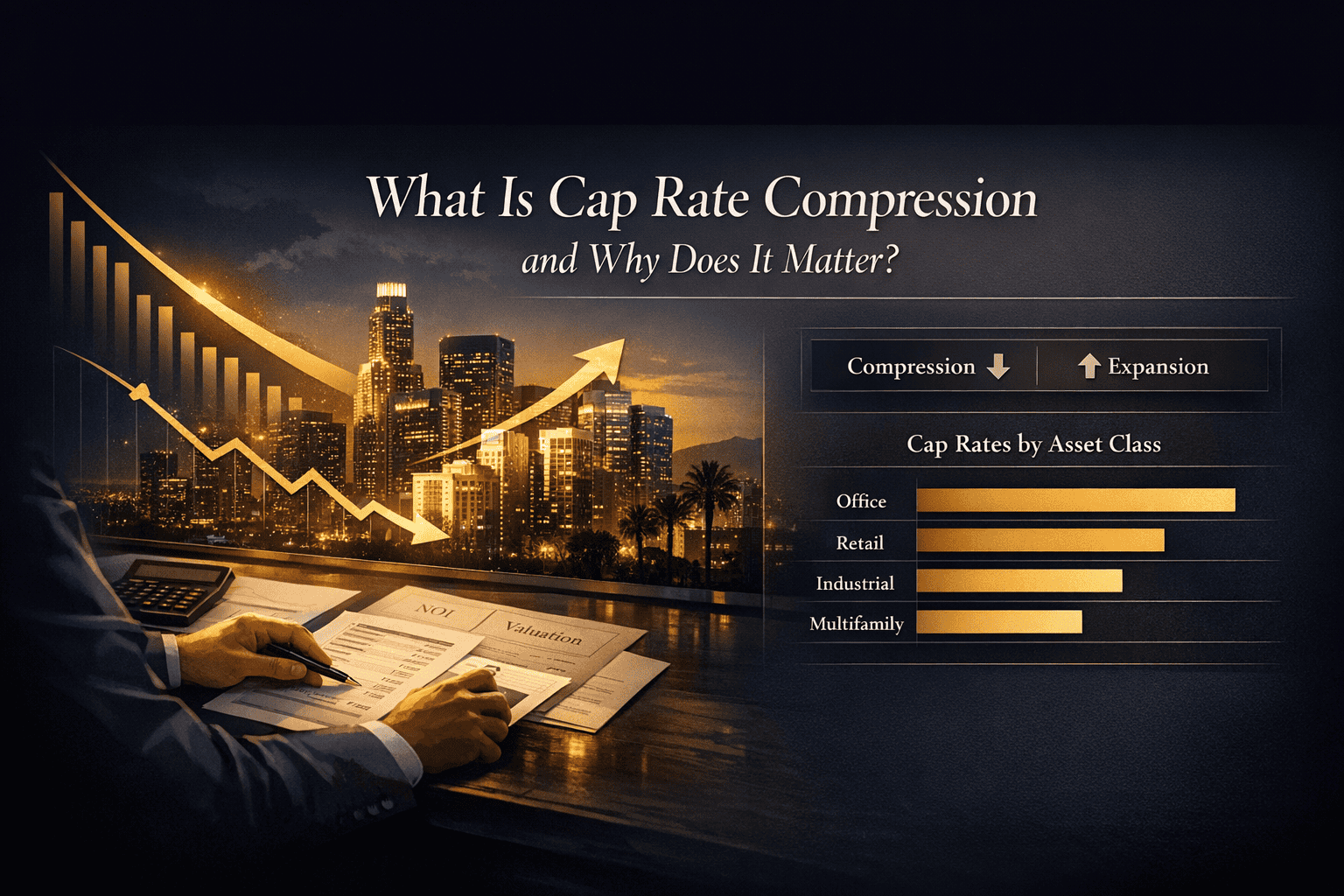
Cap Rate Compression by Asset Class
Different property types have experienced varying degrees of compression in recent years. Here's a snapshot of how compression has played out across major commercial real estate sectors:
- Multifamily: Among the most compressed asset classes, especially in Sun Belt metros. Strong renter demand, population migration, and institutional appetite have driven cap rates to historic lows in many markets.
- Industrial/Logistics: Experienced some of the most dramatic compression of any asset class over the last decade, driven by e-commerce growth and supply chain restructuring.
- Retail: A more mixed picture. Necessity-based retail (grocery-anchored centers) has held up well, while other retail sub-sectors face structural headwinds that have tempered compression.
- Office: Post-pandemic uncertainty has pushed office cap rates higher in many markets, representing cap rate expansion rather than compression.
- Net Lease (NNN): Historically low cap rates persist for investment-grade net lease properties, as they offer bond-like income streams that attract risk-averse capital.
How to Navigate a Compressed Cap Rate Environment
So how should investors respond when they find themselves operating in a market where cap rates have compressed significantly? Here are several strategic approaches:
Focus on Value-Add Opportunities
Rather than accepting a low going-in cap rate on a stabilized asset, seek properties with below-market rents, deferred maintenance, or operational inefficiencies. By improving NOI, you can create your own value rather than relying on further compression.
Explore Secondary and Tertiary Markets
While gateway markets often experience the most intense compression, smaller cities and suburban submarkets may still offer higher cap rates with improving fundamentals. The risk-reward calculus differs, but the opportunity for both income and appreciation can be compelling.
Prioritize Long-Term Income Growth
In a compressed environment, income growth becomes a primary driver of total return. Seek assets with below-market leases, strong rent growth prospects, or lease structures that provide built-in escalations. Growing NOI can expand your effective yield over time even if the purchase cap rate is low.
Stress Test Your Underwriting
Always model scenarios in which cap rates expand at exit. What happens to your returns if you buy at a 4.5% cap and sell at a 5.5% cap? If the deal still works, you have a margin of safety. If not, re-examine the purchase price or pass on the opportunity.
Consider Diversification
Spreading investment across multiple markets, asset classes, and lease structures can help mitigate the risks associated with any single market experiencing rapid expansion. Diversification doesn't eliminate risk, but it does reduce concentration exposure.
Cap Rate Compression and the Current US Market
As of the mid-2020s, the US commercial real estate market is navigating a complex environment shaped by elevated interest rates relative to the prior decade, uneven recovery across asset classes, and continued strong fundamentals in sectors like industrial and multifamily in select markets. Compression in certain asset classes and geographies remains evident, while others have seen meaningful expansion.
Investors who understand these dynamics are better positioned to identify where true value lies versus where prices reflect speculative compression that may not be sustainable. At Cordura, we believe that informed investors make better decisions — and that starts with understanding the foundational metrics like cap rates and compression that drive commercial real estate pricing.
For a deeper dive into how to evaluate investment properties using these and other metrics, explore our resources on evaluating commercial investment properties.
Final Thoughts
Cap rate compression is not inherently good or bad — it's a market signal that demands interpretation. For sellers and existing owners, it often represents significant wealth creation. For buyers, it requires greater discipline, creativity, and rigor in underwriting. For all participants in the commercial real estate market, understanding compression is essential to making sound, well-informed investment decisions.
At Cordura, we're committed to equipping investors, buyers, and property seekers across the US with the knowledge and resources they need to succeed in any market environment. Whether you're searching for your first commercial property or managing a sophisticated portfolio, understanding concepts like cap rate compression puts you in a stronger position at every stage of the investment lifecycle.