
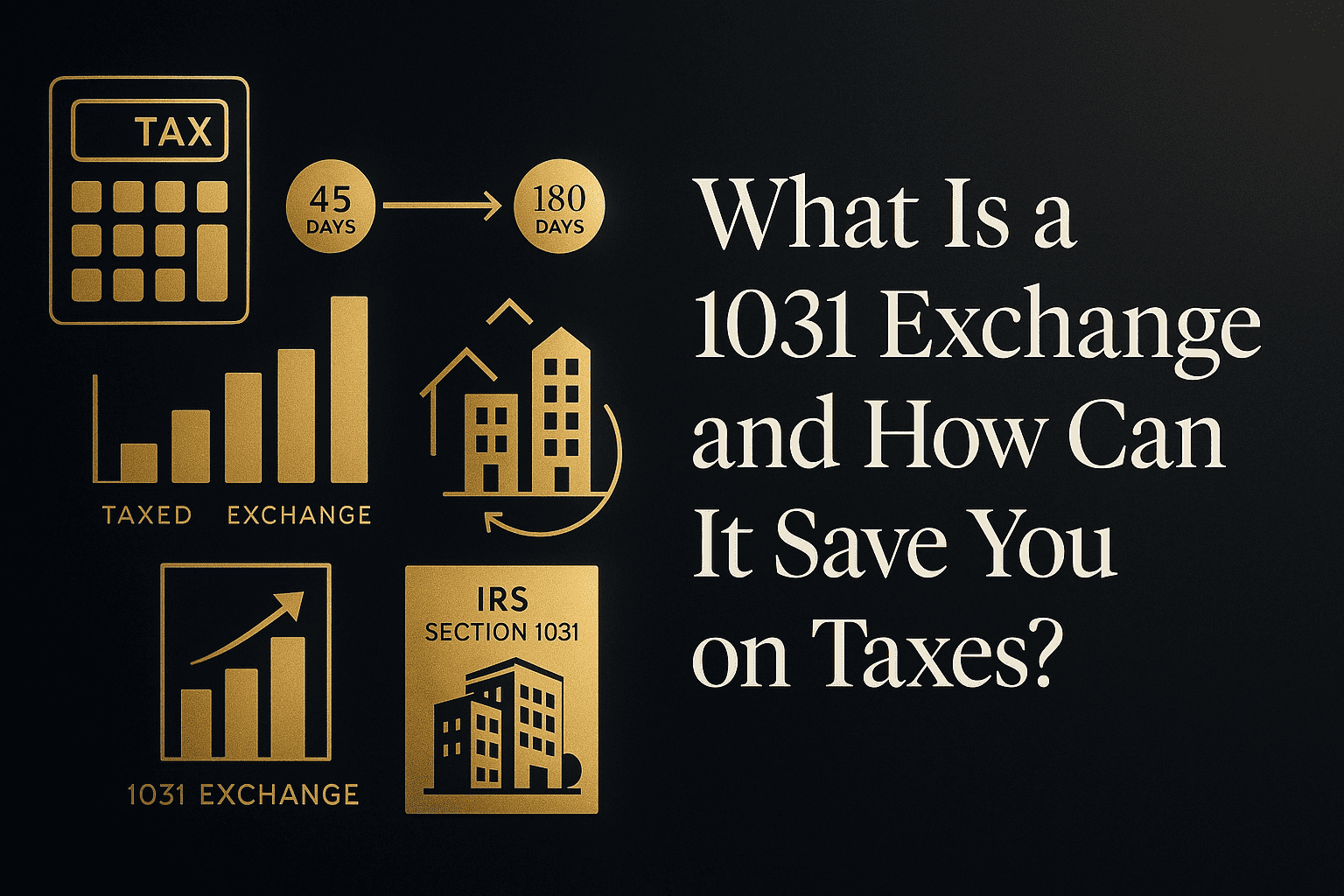
What Is a 1031 Exchange and How Can It Save You on Taxes?
If you're a real estate investor looking to grow your portfolio without losing a chunk of your profits to the IRS, a 1031 exchange could be one of the most powerful tools in your arsenal. Named after Section 1031 of the Internal Revenue Code, this tax-deferral strategy allows investors to swap one investment property for another — and defer capital gains taxes in the process. Understanding how it works can mean the difference between keeping your equity working for you and handing a significant portion of it over to the government.
What Exactly Is a 1031 Exchange?
A 1031 exchange, also known as a "like-kind exchange," is a transaction that allows a real estate investor to sell an investment property and reinvest the proceeds into another qualifying property, all while deferring federal capital gains taxes. The concept is straightforward: as long as you follow the IRS rules and reinvest into a qualifying like-kind property, you won't owe capital gains taxes at the time of the sale.
This doesn't mean you eliminate taxes entirely — it means you defer them. If you eventually sell the replacement property without doing another 1031 exchange, you'll owe taxes at that point. However, savvy investors use consecutive 1031 exchanges to defer taxes indefinitely, and in some cases, heirs can inherit property at a stepped-up basis, effectively eliminating the deferred tax liability altogether.
Who Can Benefit from a 1031 Exchange?
The 1031 exchange is designed for investors, not homeowners. To qualify, the property must be held for investment purposes or used in a trade or business. That means primary residences and vacation homes typically do not qualify — though there are some nuanced exceptions. The following types of investors commonly benefit from 1031 exchanges:
- Commercial real estate investors looking to upgrade to larger, higher-performing assets
- Landlords wanting to exit residential rentals and move into commercial properties
- Portfolio diversifiers shifting from one property type or geographic market to another
- Retirement planners consolidating multiple properties into one easier-to-manage asset
If you're actively investing in commercial real estate investing, a 1031 exchange can be a critical component of your long-term wealth-building strategy.
The Core Rules of a 1031 Exchange
The IRS has strict rules that must be followed for a 1031 exchange to qualify. Failing to meet any one of these requirements can disqualify the entire exchange and leave you with an unexpected tax bill.
1. Like-Kind Property Requirement
Both the property you're selling (the "relinquished property") and the property you're buying (the "replacement property") must be "like-kind." In real estate, this term is interpreted broadly — you can exchange a retail strip center for an apartment building, or industrial warehouse space for raw land. Essentially, any real property held for investment or business purposes qualifies as like-kind to any other real property.
2. The 45-Day Identification Rule
Once you close on the sale of your relinquished property, you have exactly 45 calendar days to identify potential replacement properties in writing. You can identify up to three properties regardless of value, or more properties if they meet specific value thresholds. This deadline is firm — the IRS does not grant extensions except in federally declared disaster areas.
3. The 180-Day Closing Rule
You must close on the purchase of the replacement property within 180 calendar days of selling your relinquished property (or by your tax filing deadline, whichever is earlier). This timeline includes the 45-day identification window, so the clock starts ticking from the moment you close on the sale.
4. The Qualified Intermediary Requirement
Perhaps the most important procedural rule: you cannot touch the sale proceeds. A Qualified Intermediary (QI) — also called an exchange facilitator — must hold the funds between the sale of the relinquished property and the purchase of the replacement property. Using an attorney, accountant, or anyone who has had a financial relationship with you in the past two years is not allowed. Choosing a reputable, independent QI is essential.
5. Equal or Greater Value
To defer 100% of your capital gains taxes, the replacement property must be of equal or greater value than the relinquished property, and all of the equity must be reinvested. If you "trade down" — buying a cheaper property or pocketing some cash — the difference (known as "boot") is taxable.
How Much Can You Actually Save?
The tax savings from a 1031 exchange can be substantial. When you sell an investment property, you may owe:
- Federal capital gains tax — up to 20% on long-term gains
- Depreciation recapture tax — 25% on previously claimed depreciation
- Net Investment Income Tax (NIIT) — an additional 3.8% for high-income earners
- State capital gains tax — varies by state, sometimes 10% or more
In total, selling a highly appreciated property without a 1031 exchange could cost you 30–40% of your gains in taxes. On a $1 million gain, that's potentially $300,000–$400,000 lost before you can reinvest. A properly executed 1031 exchange allows you to keep that capital fully invested and compounding.
Types of 1031 Exchanges
Not all 1031 exchanges are structured the same way. Depending on your investment situation, one of the following exchange types may suit your needs:
Delayed Exchange (Most Common)
This is the standard 1031 exchange structure, where you sell first and then purchase the replacement property within the 180-day window. The majority of 1031 exchanges are delayed exchanges.
Simultaneous Exchange
In a simultaneous exchange, the sale of the relinquished property and the purchase of the replacement property close on the same day. These are relatively rare and logistically complex.
Reverse Exchange
In a reverse exchange, you acquire the replacement property before selling the relinquished property. This can be advantageous in a hot market where you don't want to risk losing a great deal, but it requires specialized financing and is more expensive to execute.
Construction/Improvement Exchange
Also known as a "build-to-suit" exchange, this allows you to use exchange funds to make improvements to the replacement property before taking title. It's useful when the replacement property's value is lower than the relinquished property and you need to build equity to meet the equal-or-greater-value requirement.
Common Mistakes to Avoid
While the tax benefits of a 1031 exchange are compelling, the process is unforgiving. Here are some pitfalls investors commonly encounter:
- Missing the 45-day or 180-day deadlines — There are no extensions, so start identifying replacement properties before you close on the sale.
- Touching the proceeds — Even briefly receiving the funds disqualifies the exchange. Always use a Qualified Intermediary.
- Identifying too few properties — Markets move fast; identify the maximum allowable properties to give yourself flexibility.
- Underestimating boot — Mortgage boot (taking on less debt) is taxable just like cash boot. Be mindful of your financing structure.
- Not consulting a tax professional — 1031 exchanges have significant tax implications. Always work with a CPA and a real estate attorney familiar with exchange rules.
1031 Exchanges and Commercial Real Estate
For commercial real estate investors, 1031 exchanges are particularly valuable because commercial properties often appreciate significantly and carry substantial depreciation recapture obligations. Whether you're buying commercial property for the first time or transitioning between asset classes, structuring the transaction as a 1031 exchange can dramatically improve your after-tax returns.
Common commercial real estate exchange scenarios include:
- Selling a multifamily apartment complex and acquiring an office building
- Exchanging a single-tenant retail property for a net lease industrial facility
- Moving from active management of rental units into a passive Delaware Statutory Trust (DST)
Delaware Statutory Trusts: A 1031-Friendly Option
One increasingly popular strategy for investors who want to defer taxes but step away from active management is investing in a Delaware Statutory Trust (DST). A DST is a legally structured entity that holds real estate and is considered like-kind property for 1031 exchange purposes. Investors can own a fractional interest in institutional-grade properties — such as large apartment complexes, distribution centers, or medical office buildings — without the headaches of day-to-day management.
DSTs are particularly appealing to older investors planning for retirement who want to keep their equity working but reduce their landlord responsibilities.
Is a 1031 Exchange Right for You?
A 1031 exchange isn't the right strategy for every investor in every situation. It's most beneficial when you have significant capital gains and a clear plan for reinvestment. Here are some questions to consider:
- Do you have substantial appreciation or depreciation recapture on a property you want to sell?
- Are you prepared to identify and close on a replacement property within the strict IRS timelines?
- Do you have a Qualified Intermediary in place before you close on the sale?
- Is your investment goal long-term wealth accumulation rather than immediate liquidity?
If you answered yes to most of these, a 1031 exchange deserves serious consideration. Explore our investment property listings to find qualified replacement properties across the country and start planning your exchange today.
Final Thoughts
A 1031 exchange is one of the most powerful tax-deferral strategies available to real estate investors in the United States. By carefully following IRS rules — identifying like-kind replacement properties within 45 days and closing within 180 days — investors can keep their capital fully deployed and growing, rather than losing a substantial portion to taxes. When executed correctly with the help of qualified professionals, a 1031 exchange is not just a tax strategy — it's a wealth-building accelerator.
At Cordura, we work with investors across all commercial real estate asset classes to help them identify, evaluate, and acquire the right properties to meet their investment goals — including those planning 1031 exchanges. Contact our team today to learn how we can help you make your next move.