The Future of Office Space: How Hybrid Work Is Reshaping Commercial Real Estate
The way we work has changed permanently. The pandemic-era experiment with remote work didn't just temporarily empty office buildings — it fundamentally rewired employee expectations, corporate strategies, and the entire commercial real estate landscape. Today, hybrid work models dominate the conversation, and for investors, buyers, and property seekers, understanding what this shift means for office space is no longer optional — it's essential.
At Cordura, we work closely with clients navigating today's evolving office market. Whether you're an investor evaluating opportunities or a business searching for your next headquarters, the hybrid work revolution demands a fresh perspective on what office space should look like, where it should be located, and how it should be priced.
What Is the Hybrid Work Model?
Hybrid work blends remote and in-office schedules, giving employees flexibility while maintaining a physical workspace for collaboration, culture-building, and focused work. According to data from McKinsey, over 58% of Americans have the opportunity to work remotely at least part of the time — and most of them are taking it.
Companies like Google, Apple, Microsoft, and thousands of mid-size businesses have adopted hybrid policies ranging from two to three days in-office per week. This shift has direct consequences for how much space companies need, how they design their offices, and where they choose to locate.
How Hybrid Work Is Changing Office Space Demand
1. Downsizing Square Footage — But Not Disappearing
One of the most discussed consequences of hybrid work is office downsizing. If employees are only in the office a few days a week, companies can reduce their footprint significantly. Many major corporations have already shed millions of square feet of office space since 2020.
However, it's critical to understand that this doesn't mean the death of the office. It means the right-sizing of the office. Businesses still need physical space — they're simply rethinking how much and for what purpose. The emphasis has shifted from individual workstations to collaborative zones, meeting rooms, and amenity-rich environments that give employees a compelling reason to commute.
2. Flight to Quality: Class A Properties Are Thriving
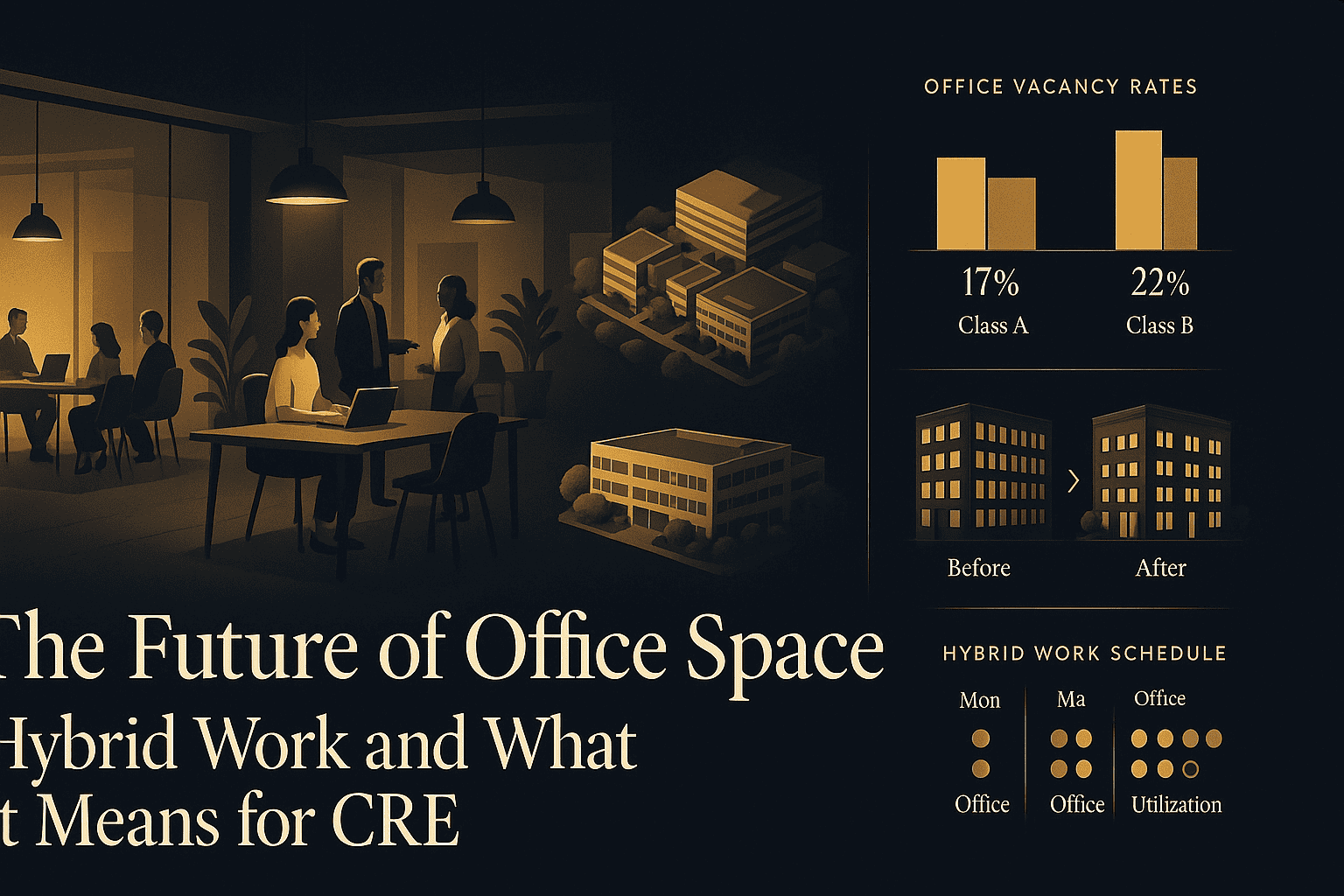
Perhaps the most significant trend in today's office market is the "flight to quality." While overall office vacancy rates remain elevated in many markets, Class A and Trophy office buildings are outperforming significantly. Companies may be leasing less space, but they're willing to pay premium rates for buildings that offer:
- Modern, flexible floor plans
- Advanced HVAC and air filtration systems
- High-speed connectivity and smart building technology
- On-site amenities like fitness centers, cafes, and conference facilities
- Sustainable design and LEED certification
- Strong transit access and walkable neighborhoods
For investors, this flight to quality represents a critical signal: not all office assets are created equal in the hybrid era. Older, commodity office buildings with limited amenities face the steepest headwinds, while well-located, modern properties command strong occupancy and rent growth. If you're evaluating commercial real estate investment opportunities, understanding this quality divide is foundational to making sound decisions.
3. Suburban Office Markets Are Gaining Ground
A noteworthy geographic shift has accompanied the hybrid revolution. Suburban office markets — once considered secondary to major urban CBDs — have seen renewed interest. Employees who now commute only two or three days per week are less willing to endure long commutes into city centers. Suburban office parks and mixed-use developments that offer shorter commutes, ample parking, and a more relaxed environment are increasingly attractive to both tenants and investors.
Sun Belt cities like Austin, Nashville, Charlotte, and Phoenix have been particular beneficiaries of this trend, combining suburban accessibility with urban amenities and favorable business climates. For property seekers exploring options outside gateway markets, suburban submarkets offer compelling value relative to downtown alternatives.
4. Lease Terms and Structures Are Evolving
Hybrid work has introduced significant uncertainty for corporate real estate decision-makers. Many companies are reluctant to commit to traditional 10-year leases when their long-term space needs remain unclear. This has pushed the market toward more flexible lease structures, including:
- Shorter lease terms: Three to five year leases are increasingly common, especially for smaller tenants.
- Flexible co-working and managed office arrangements: Operators like WeWork, Industrious, and Regus have found renewed relevance as companies seek flexibility without long-term commitments.
- Expansion and contraction options: Tenants are negotiating more aggressively for rights to scale their space up or down as workforce needs change.
For landlords and investors, these dynamics require strategic thinking about lease roll exposure and tenant mix. Diversified tenant rosters across industries and lease expirations can help mitigate risk in an uncertain demand environment.
The Office Reimagined: Design Trends Driving the Future
The offices that will thrive in the hybrid era aren't just smaller versions of their predecessors — they're fundamentally different in design philosophy. Leading companies are investing heavily in office environments that serve as magnets rather than mandates, creating spaces employees genuinely want to visit.
Activity-Based Working (ABW)
Rather than assigning every employee a dedicated desk, forward-thinking companies are implementing activity-based working environments. These offices feature a variety of settings designed for different work modes: quiet focus rooms for deep work, open collaboration zones for team brainstorming, video-conferencing pods for hybrid meetings, and social lounges for casual interaction. The result is a dynamic, efficient use of space that accommodates fluctuating daily attendance without wasted square footage.
Hospitality-Inspired Amenities
The most competitive office buildings today look more like boutique hotels than traditional workplaces. Tenants and their employees expect barista coffee bars, curated food and beverage programs, rooftop terraces, meditation rooms, and concierge-style services. Building owners who invest in these amenity packages are commanding significant rent premiums and experiencing faster lease-up timelines.
Technology Integration
Hybrid work creates a persistent challenge: how do you ensure that remote workers and in-office employees have equitable meeting experiences? This has accelerated investment in room-booking technology, advanced AV systems, and smart building platforms that allow seamless hot-desking, space utilization tracking, and environmental controls. Buildings equipped with cutting-edge technology infrastructure have a decisive competitive advantage in attracting and retaining tenants.
Vacancy Challenges and the Conversion Opportunity
It would be incomplete to discuss the future of office space without acknowledging the genuine challenges facing the sector. National office vacancy rates have climbed above 18% in many markets — a multi-decade high — and distressed office assets are accumulating on lender balance sheets. Remote-heavy industries like tech have executed some of the most dramatic space reductions, leaving behind large blocks of sublease space that weigh on market fundamentals.
Yet embedded within this challenge lies one of the most compelling opportunities in commercial real estate today: office-to-residential conversion. Municipalities across the country, from New York City to Los Angeles to Chicago, are actively incentivizing the conversion of obsolete office buildings into much-needed housing. For investors and developers, these adaptive reuse projects offer a path to unlock value from underperforming assets while addressing the nation's housing shortage.
Not every office building is a good conversion candidate — floor plate sizes, floor-to-ceiling heights, and core configurations all matter — but for properties that meet the criteria, conversions can be highly attractive investments. Explore our resources on adaptive reuse real estate to learn more about evaluating these opportunities.
What This Means for CRE Investors in 2024 and Beyond
The office sector is not a monolith. It's a complex, segmented market where the right assets in the right locations can deliver strong risk-adjusted returns, while poorly positioned properties face prolonged pain. For investors evaluating office exposure today, here are the key principles to apply:
- Focus on quality over quantity: Prioritize Class A and Trophy assets with strong amenity packages, modern infrastructure, and transit access.
- Know your markets: Sun Belt and growing secondary markets offer stronger demand fundamentals than many traditional gateway CBDs.
- Evaluate tenant credit carefully: In a market with elevated vacancy, tenant financial strength and lease term are more important than ever.
- Consider value-add and conversion plays: Distressed office assets trading at significant discounts may offer compelling entry points for investors with the expertise to reposition or convert.
- Think about lease structure: Shorter average lease terms mean more frequent re-leasing risk; underwrite accordingly and price in capital costs for tenant improvements.
For buyers and tenants navigating the office market, the hybrid era actually provides significant negotiating leverage. Landlords of all but the most in-demand buildings are offering generous concession packages including free rent periods, substantial tenant improvement allowances, and flexible lease structures. There has rarely been a better time to secure premium office space at favorable terms.
Looking Ahead: The Office Is Dead — Long Live the Office
Reports of the office's death have been greatly exaggerated. What's actually happening is more nuanced and, for sophisticated CRE participants, more interesting. The office is undergoing its most significant transformation in generations, shedding outdated models and emerging as a more purposeful, experience-rich, and strategically designed environment.
Hybrid work hasn't eliminated the need for physical workspace — it has elevated the standards that physical workspaces must meet. Companies that get their office strategy right will attract and retain top talent. Investors who identify the right assets and submarkets will generate strong returns even as the overall market continues to reset. And tenants who negotiate wisely in today's favorable environment will secure spaces that serve their teams for years to come.
At Cordura, our team tracks office market trends across the US to help our clients make informed, confident decisions. Whether you're exploring office space listings for your growing business or evaluating investment opportunities in the sector, we're here to provide the market intelligence and expertise you need to succeed.
Partner With Cordura to Navigate the Hybrid Office Market
The commercial real estate landscape is evolving rapidly, and the office sector sits at the center of one of the most dynamic stories in the industry. At Cordura, we combine deep market expertise with a client-first approach to help investors, buyers, and tenants capitalize on today's opportunities and navigate its challenges.
Ready to explore what the future of office space means for your portfolio or your business? Connect with a Cordura advisor today and take the first step toward smarter commercial real estate decisions.