Sustainability in CRE: Why Green Buildings Are Winning Tenants
The commercial real estate landscape is undergoing a fundamental transformation. Sustainability is no longer a niche concern or a corporate checkbox — it has become a decisive factor in leasing decisions, asset valuations, and long-term investment performance. Across the US market, green buildings are consistently outperforming their conventional counterparts in occupancy rates, rental premiums, and tenant retention. For investors and property owners working with Cordura, understanding this shift isn't optional — it's essential.
What Makes a Building "Green"?
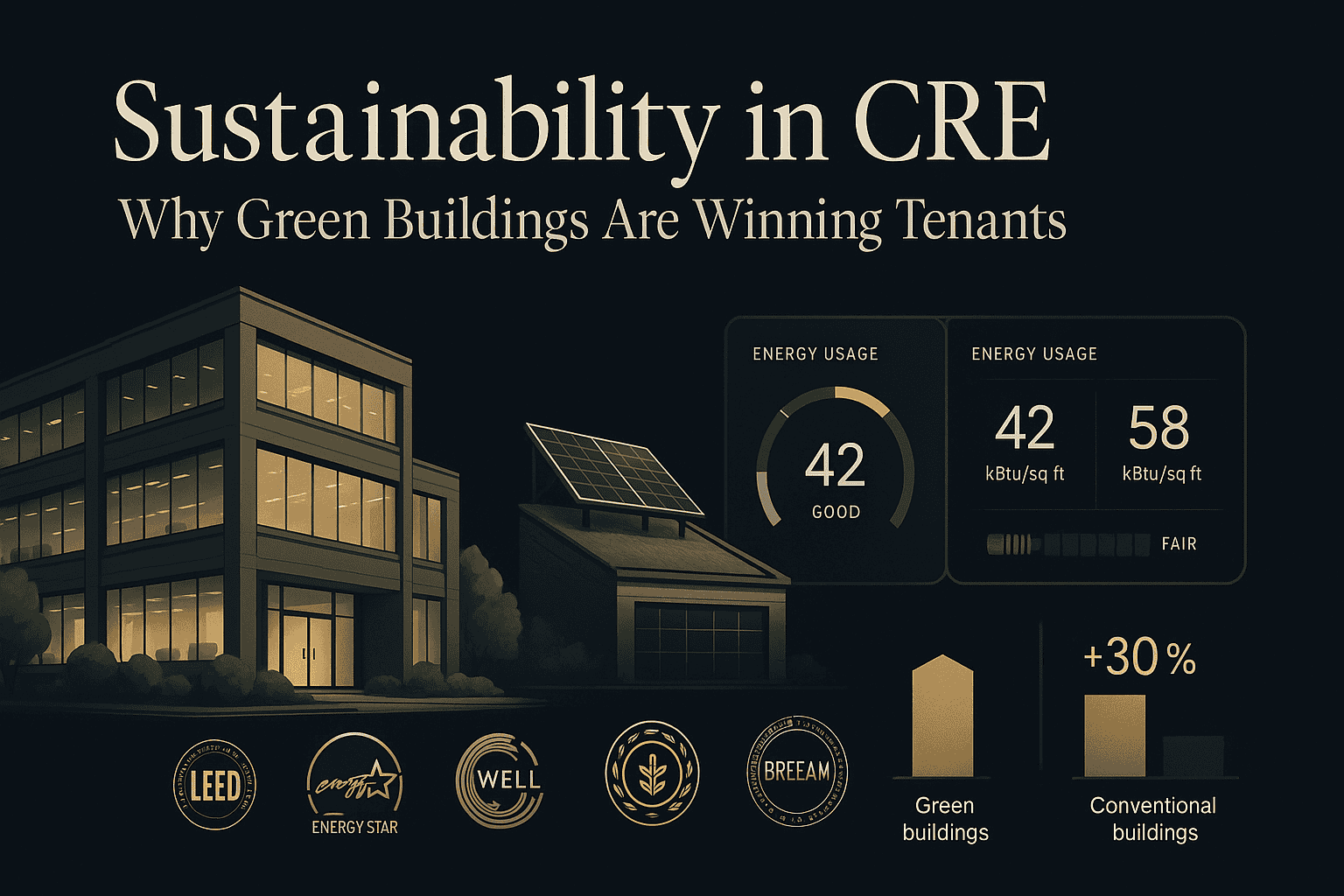
A green building is one designed, constructed, and operated to reduce its environmental footprint while improving the health and productivity of its occupants. Key certifications and standards define what qualifies:
- LEED (Leadership in Energy and Environmental Design): The most widely recognized standard in the US, covering energy efficiency, water conservation, indoor air quality, and sustainable materials.
- ENERGY STAR: A EPA-backed label awarded to buildings that perform in the top 25% for energy efficiency.
- WELL Building Standard: Focuses specifically on occupant health and wellness, covering air, water, light, and nourishment.
- BREEAM: An international standard gaining traction among multinational tenants seeking global consistency.
These certifications signal to tenants, investors, and lenders that a property meets rigorous environmental and operational benchmarks — and increasingly, the market rewards that signal with tangible financial returns.
The Tenant Demand Shift Is Real — and Growing
Corporate sustainability commitments have moved from boardroom aspirations to lease requirements. Major companies — from Fortune 500 corporations to fast-growing tech firms — now include sustainability criteria in their real estate procurement processes. A 2023 CBRE survey found that over 70% of corporate tenants consider sustainability features a priority when selecting office space, and that number continues to climb.
Why? Because tenants face pressure from multiple directions simultaneously. Investors, regulators, and employees are all demanding measurable ESG (Environmental, Social, and Governance) performance. Leasing a certified green building allows tenants to demonstrate progress on their own sustainability goals without bearing the full cost of retrofitting. This creates a direct competitive advantage for building owners who invest in green credentials.
Beyond corporate responsibility, there is a practical workforce dimension. Employees increasingly prefer to work in spaces with better air quality, natural light, and thermal comfort. Research published by Harvard's T.H. Chan School of Public Health found that workers in green-certified buildings scored 26% higher on cognitive function tests compared to those in conventional spaces. For talent-competitive industries, that translates directly to recruiting and retention leverage.
Green Buildings Command Premium Rents and Higher Occupancy
The financial case for green buildings is no longer theoretical. A growing body of market data confirms that sustainability-certified properties achieve measurably better financial outcomes:
- Rental premiums: LEED-certified office buildings command rental premiums of 5–10% over comparable non-certified properties, according to JLL research.
- Lower vacancy rates: Green buildings consistently show lower vacancy rates — in some markets, 4–8 percentage points below the market average.
- Faster lease-up: Newly constructed or retrofitted green buildings tend to attract anchor tenants faster, reducing the costly period of empty square footage.
- Longer lease terms: Tenants in green buildings sign longer leases on average, reducing turnover costs for owners.
For investors evaluating acquisitions, these metrics translate directly into superior net operating income (NOI) and cap rate compression — meaning green assets trade at higher prices relative to their income. If you're looking to explore commercial real estate investment opportunities with strong long-term performance potential, sustainability-certified assets deserve serious attention in your portfolio strategy.
Regulatory Tailwinds Are Accelerating the Green Premium
Federal, state, and local governments are increasingly mandating sustainability improvements across commercial real estate. Building owners who act proactively are ahead of this curve — those who wait face the risk of stranded assets and costly forced compliance.
Key Regulatory Drivers in the US Market
- New York City Local Law 97: Requires large buildings to meet strict carbon emission limits, with significant fines for non-compliance starting in 2024.
- California Title 24: Energy efficiency standards that apply to new construction and major renovations statewide.
- SEC Climate Disclosure Rules: Proposed rules requiring public companies to disclose climate-related risks, intensifying demand for accurate building-level emissions data.
- IRA Clean Energy Incentives: The Inflation Reduction Act offers substantial tax credits for energy-efficient commercial building upgrades, making green retrofits more financially accessible.
As regulatory frameworks tighten, buildings that already meet or exceed green standards will face significantly lower compliance costs and reduced obsolescence risk. Conversely, aging, energy-inefficient properties face increasing devaluation as the cost of bringing them up to code escalates. This dynamic is reshaping how sophisticated investors underwrite CRE acquisitions today.
The Retrofit Opportunity: Turning Conventional Assets Green
Not every green building opportunity starts with ground-up development. Retrofitting existing commercial properties represents one of the most compelling value-add strategies in today's market. A well-executed sustainability retrofit can reposition a Class B asset into Class A territory, command higher rents, attract better-quality tenants, and significantly extend the economic life of the property.
High-Impact Retrofit Strategies
- LED lighting upgrades: One of the most cost-effective investments, typically delivering a 2–3 year payback period while dramatically reducing energy consumption.
- HVAC modernization: Upgrading to high-efficiency HVAC systems improves both energy performance and indoor air quality — two key tenant priorities.
- Building automation systems (BAS): Smart controls that optimize energy use in real time, reducing waste without sacrificing occupant comfort.
- EV charging infrastructure: Increasingly expected by tenants with sustainability commitments and employees with electric vehicles.
- Green roofs and solar panels: Reduce energy costs, manage stormwater, and improve building aesthetics and marketability.
Property owners considering retrofit projects should conduct a comprehensive energy audit before prioritizing investments. Many utilities and local governments offer incentive programs that can significantly offset upfront costs. When evaluating properties through Cordura's property listings, understanding the sustainability upgrade potential of a given asset is a critical part of due diligence.
Industrial and Retail: Green Is Expanding Beyond Office
While much of the early sustainability conversation in CRE focused on office buildings, the green trend is now firmly established across all property sectors.
Industrial Real Estate
The explosive growth of e-commerce has made industrial properties a sustainability hotspot. Major logistics tenants — including Amazon, Walmart, and third-party logistics providers — now require LEED certification or equivalent standards for new leases. Solar-ready roof structures, EV charging for last-mile delivery fleets, and energy-efficient lighting systems are becoming standard requirements rather than amenities.
Retail and Mixed-Use
Retailers increasingly incorporate sustainability into their brand identity, and their brick-and-mortar locations must reflect those values. Green-certified retail properties attract national tenants with strong ESG commitments, and sustainable design features — from living walls to natural ventilation — enhance the consumer experience and drive foot traffic.
Multifamily Commercial Properties
For multifamily and mixed-use commercial investors, green features such as energy-efficient appliances, solar installations, and EV charging stations are commanding premium rents from environmentally conscious residents, while also reducing operating costs through lower utility expenses.
How Lenders and Investors Are Pricing Sustainability
The capital markets have fully internalized the green premium. Green loans and sustainability-linked financing products are now mainstream in commercial real estate lending:
- Green bonds and green loans: Properties meeting certified sustainability standards qualify for preferential financing terms, including lower interest rates and more favorable covenants.
- PACE financing: Property Assessed Clean Energy programs allow building owners to finance energy efficiency and renewable energy upgrades through property tax assessments, preserving liquidity.
- Institutional ESG mandates: Major pension funds, REITs, and institutional investors now screen acquisitions against ESG criteria, concentrating capital into green-certified assets and creating demand-driven price support.
This capital market dynamic creates a self-reinforcing cycle: green buildings attract better tenants, command higher rents, achieve lower vacancy, access cheaper financing, and trade at premium valuations — which in turn justifies the investment required to achieve and maintain green certification.
Risk Management: The Cost of Doing Nothing
For property owners who haven't yet engaged with sustainability, the risks of inaction are escalating rapidly. The concept of "stranded assets" — properties that lose value due to environmental non-compliance or obsolescence — is no longer hypothetical in major US markets.
Buildings that fail to meet emerging regulatory standards face fines, retrofit mandates, and reduced marketability. Tenants with strong sustainability commitments will increasingly avoid non-certified properties, concentrating demand in green inventory and leaving conventional assets with higher vacancy and downward pressure on rents. Insurance markets are also beginning to price climate-related physical risks more aggressively, increasing operating costs for properties in high-risk locations without resilience features.
Understanding these risks is a core part of sound commercial real estate market analysis and portfolio strategy in today's environment.
Getting Started: A Practical Sustainability Roadmap for CRE Owners
If you own or are considering acquiring commercial real estate and want to position your assets for the green premium, here is a practical starting framework:
- Step 1 — Benchmark current performance: Use ENERGY STAR Portfolio Manager to establish baseline energy and water consumption metrics.
- Step 2 — Conduct an energy audit: Identify the highest-impact, most cost-effective improvement opportunities specific to your property.
- Step 3 — Prioritize certifications strategically: Determine which certification (LEED, ENERGY STAR, WELL) aligns best with your tenant base and market positioning.
- Step 4 — Explore financing options: Investigate PACE financing, IRA tax credits, utility incentives, and green loan products before funding retrofits from operating capital.
- Step 5 — Communicate with tenants: Engage existing tenants in your sustainability journey — many will participate in green lease structures that share the costs and benefits of sustainability improvements.
- Step 6 — Market your credentials: Ensure your property's certifications and sustainability features are prominently communicated in all marketing materials, listings, and broker outreach.
The Cordura Perspective: Sustainability as a Core Investment Thesis
At Cordura, we work with investors and property seekers across the US market who are navigating an increasingly complex commercial real estate environment. Sustainability is not a trend we expect to reverse — it is a structural shift in how tenants, capital, and regulators value commercial property. The buildings winning tenants today, and the assets delivering superior returns to investors, are overwhelmingly those that take environmental performance seriously.
Whether you are evaluating a new acquisition, considering a value-add retrofit, or seeking to lease space in a property that aligns with your company's sustainability commitments, understanding the green building landscape is fundamental to making informed decisions. The market has spoken: sustainability is no longer a differentiator — it is increasingly the baseline expectation.
Connect with Cordura to explore green-certified commercial properties and investment opportunities across the US market that are positioned to win in the sustainability-driven future of CRE.