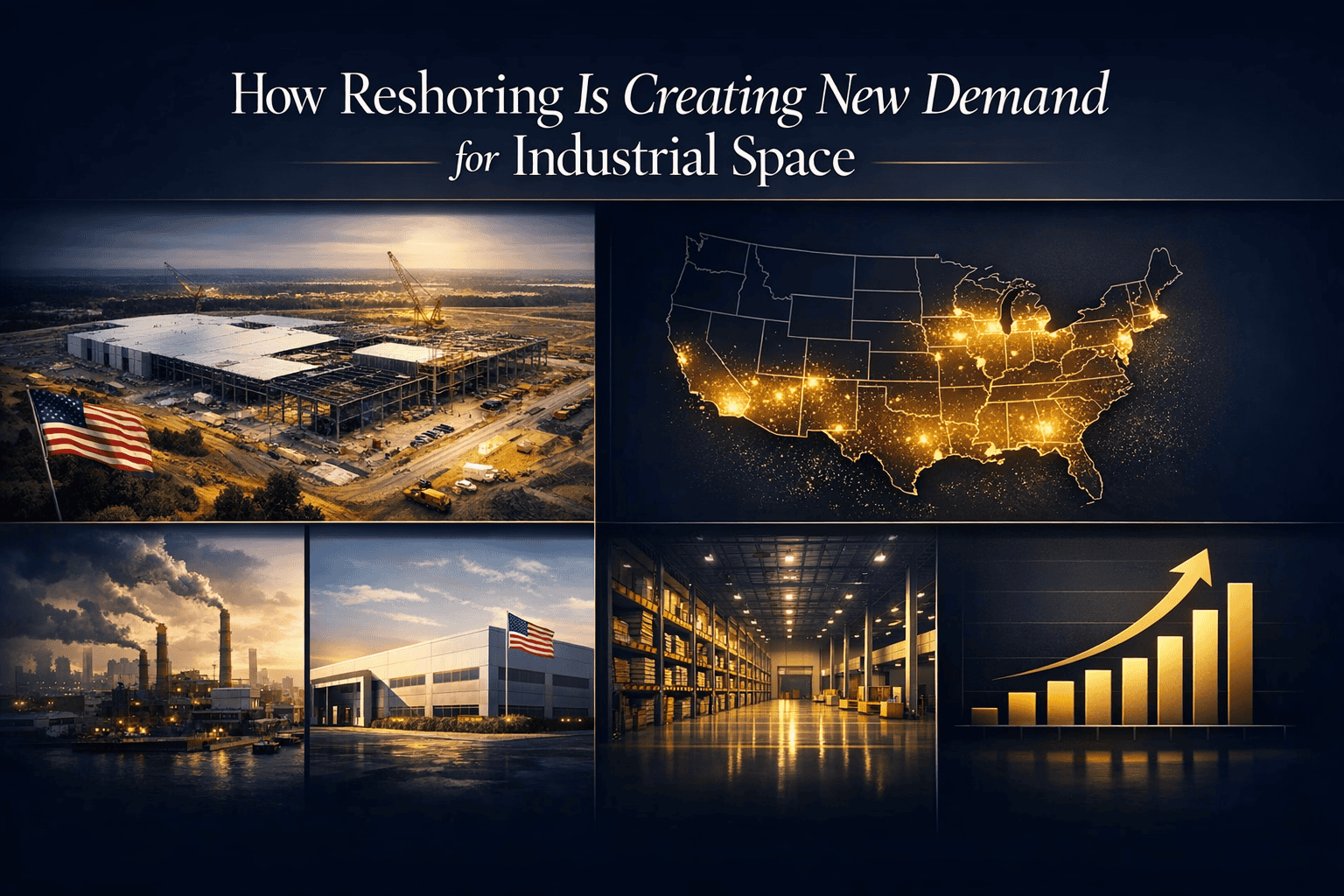
How Reshoring Is Creating New Demand for Industrial Space
A fundamental shift is underway in the American economy. After decades of offshoring manufacturing operations to lower-cost countries, U.S. companies are bringing production back home — a trend known as reshoring. Driven by supply chain disruptions, geopolitical tensions, rising overseas labor costs, and new federal incentives, reshoring is accelerating at an unprecedented pace. For commercial real estate investors and industrial property seekers, this transformation is generating significant new demand for warehouses, distribution centers, and manufacturing facilities across the country.
Understanding how reshoring intersects with industrial real estate is essential for anyone looking to capitalize on one of the most powerful long-term trends in the U.S. property market.
What Is Reshoring and Why Is It Happening Now?
Reshoring refers to the practice of returning manufacturing, assembly, and supply chain operations that were previously moved overseas back to the United States. A related concept — nearshoring — involves relocating operations to neighboring countries like Mexico or Canada, which also benefits U.S. industrial real estate through increased cross-border logistics activity.
Several converging forces have accelerated this trend dramatically over the past few years:
- Supply Chain Vulnerabilities: The COVID-19 pandemic exposed how fragile globally distributed supply chains could be. Shortages of semiconductors, medical supplies, and consumer goods prompted companies to rethink their dependence on foreign suppliers.
- Geopolitical Risk: Rising tensions with China and other trading partners have made long-distance supply chains a strategic liability for many industries.
- Rising Overseas Costs: Labor costs in countries like China have increased significantly, narrowing the cost advantage that originally drove offshoring decisions.
- Federal Incentives: The CHIPS and Science Act, the Inflation Reduction Act, and the Infrastructure Investment and Jobs Act have collectively allocated hundreds of billions of dollars to support domestic manufacturing in semiconductors, clean energy, electric vehicles, and infrastructure.
- Consumer and Investor Sentiment: "Made in America" branding carries increasing value with consumers, and ESG-focused investors are increasingly scrutinizing supply chain sustainability.
The Reshoring Initiative, a nonprofit that tracks manufacturing job announcements, reported that reshoring and foreign direct investment (FDI) announcements in the U.S. hit record highs in recent years, with hundreds of thousands of jobs announced annually. Each of those jobs requires physical space — and that is where industrial real estate comes in.
The Industrial Real Estate Boom Driven by Reshoring
Industrial real estate — which includes manufacturing plants, distribution centers, warehouses, cold storage facilities, and flex industrial spaces — has been one of the best-performing asset classes in commercial real estate for several years. Reshoring is a primary engine behind this performance, and its effects are expected to intensify over the coming decade.
Manufacturing Facilities
The most direct impact of reshoring is the demand for new or modernized manufacturing facilities. Companies returning production to the U.S. need purpose-built or adaptable industrial buildings. Semiconductor fabrication plants (fabs), electric vehicle battery gigafactories, pharmaceutical manufacturing facilities, and advanced robotics assembly plants all require large, specialized industrial spaces. These facilities often span millions of square feet and carry enormous construction and lease values.
Warehousing and Distribution Centers
Reshoring doesn't just increase demand for production space — it also reshapes logistics networks. As domestic manufacturing ramps up, companies need nearby warehousing to store raw materials, work-in-progress inventory, and finished goods. The result is increased demand for last-mile distribution centers and large-format logistics hubs strategically positioned near manufacturing clusters and population centers.
Flex Industrial and R&D Space
Not all reshored operations are traditional heavy manufacturing. Many involve research and development, light assembly, or advanced manufacturing techniques that require flexible industrial space with high ceilings, significant power capacity, and proximity to skilled labor pools. This demand for flex industrial space is growing rapidly in technology corridors and university towns across the U.S.
If you're exploring opportunities in this space, browse our industrial property listings to find assets aligned with these high-demand categories.
Geographic Hotspots for Reshoring-Driven Industrial Demand
Reshoring activity is not evenly distributed across the United States. Certain regions are emerging as dominant hubs for new manufacturing investment, driven by factors like available land, labor costs, energy access, transportation infrastructure, and proximity to existing supply chain ecosystems.
The Sun Belt
States like Texas, Arizona, Georgia, and Tennessee have attracted enormous reshoring investments, particularly in electric vehicles, semiconductors, and advanced manufacturing. Major announcements include Taiwan Semiconductor Manufacturing Company's (TSMC) $40+ billion fab complex in Phoenix, multiple EV and battery plants across the Southeast, and a growing ecosystem of suppliers and logistics providers clustering nearby.
The Midwest
Traditional manufacturing states like Ohio, Michigan, Indiana, and Wisconsin are experiencing a resurgence as automotive OEMs and their suppliers transition to electric vehicle production. The "Battery Belt" stretching across the Midwest and Southeast is one of the most active zones for new industrial development in the country.
The Mid-Atlantic and Southeast
The I-95 corridor and Southeastern states benefit from major port access, lower land costs compared to gateway markets, and business-friendly regulatory environments. These factors make them attractive for distribution-heavy reshoring operations tied to import substitution strategies.
Inland Empire and Western Markets
California's Inland Empire remains a critical logistics hub despite higher costs, while secondary Western markets in Nevada, Utah, and Idaho are gaining traction as companies seek alternatives that still offer access to West Coast ports and growing labor pools.
Key Industrial Property Characteristics in High Demand
Reshoring is not just about quantity of industrial space — it is also reshaping the qualitative requirements that tenants and owner-occupiers demand. Investors and developers need to understand what modern reshored manufacturers are looking for:
- High Power Capacity: Advanced manufacturing, EV charging infrastructure, and data-intensive production require significantly more electrical capacity than traditional warehouses. Properties with robust power infrastructure command premium rents.
- Clear Heights: Modern manufacturing and logistics operations typically require clear heights of 32 feet or greater, with many larger facilities demanding 40 feet or more.
- Heavy Floor Loads: Industrial machinery and dense product storage require reinforced concrete floors rated for high pounds-per-square-foot loads.
- Rail and Port Proximity: For raw material-intensive manufacturing, access to rail spurs or proximity to intermodal facilities significantly reduces operating costs.
- Skilled Labor Access: Facilities near community colleges, technical training institutions, and established manufacturing workforce clusters are preferred for advanced manufacturing operations.
- Environmental and Permitting Readiness: Speed-to-market is critical for reshored manufacturers. Properties with pre-approved entitlements, clean environmental records, and available utilities are at a premium.
Investment Implications for Commercial Real Estate
For investors, the reshoring trend creates compelling opportunities across multiple industrial real estate strategies:
Core and Core-Plus Industrial
Stabilized industrial assets in reshoring hotspots are attracting strong institutional capital. Cap rate compression in top-tier industrial markets has been driven in part by the perceived long-term stability of manufacturing-related tenancies, which tend to sign longer leases with significant capital investment in tenant improvements.
Value-Add Industrial
Older manufacturing facilities in strategic locations represent value-add opportunities as investors reposition them to meet modern specifications. Properties that can be upgraded to higher power capacity, improved clear heights, and contemporary dock configurations are well-positioned to capture reshoring-driven lease demand.
Industrial Development
Build-to-suit and speculative industrial development has surged in reshoring corridors. Developers with access to entitled land near transportation infrastructure and labor pools are capturing significant pre-lease activity from reshored manufacturers seeking custom-built facilities.
Understanding market fundamentals is critical before making industrial investments. Read our commercial real estate market analysis to stay ahead of shifting demand dynamics across key U.S. industrial markets.
Challenges and Considerations for Industrial Property Stakeholders
While the reshoring trend presents enormous opportunity, it also comes with important challenges that industrial real estate stakeholders must navigate:
- Construction Cost Pressures: Rising material and labor costs have increased the cost of delivering new industrial supply, compressing development margins and extending timelines.
- Land Scarcity in Key Markets: In markets like Phoenix, Nashville, and the Inland Empire, available industrial land is increasingly scarce, pushing development to secondary locations and inflating land values.
- Permitting and Entitlement Delays: Large-scale manufacturing projects often face complex permitting processes, environmental reviews, and community opposition that can delay delivery schedules by months or years.
- Infrastructure Gaps: Some emerging industrial markets lack the utility capacity, road infrastructure, or broadband connectivity required by advanced manufacturers, requiring coordinated public-private investment.
- Workforce Development: The availability of skilled manufacturing labor remains a constraint in many markets, limiting the attractiveness of otherwise well-positioned properties.
Investors and tenants who conduct rigorous due diligence on these factors will be better positioned to identify properties that will outperform in the reshoring era.
How Cordura Helps You Navigate Industrial Real Estate Opportunities
At Cordura, we understand that the reshoring trend is reshaping industrial real estate demand at a pace that requires real-time market intelligence and deep local expertise. Whether you're an institutional investor seeking core industrial assets in reshoring hotspots, a developer looking to capitalize on build-to-suit opportunities, or a manufacturing company searching for the right facility to support your domestic expansion, our team is equipped to help you identify and execute on the right opportunities.
Our comprehensive listings platform and market research tools give you access to industrial properties across key U.S. markets, with detailed information on power capacity, zoning, labor access, and infrastructure to help you match properties to your specific reshoring-related requirements. Connect with a Cordura advisor today to discuss your industrial real estate strategy and how to position yourself to benefit from the reshoring revolution.
Conclusion: Reshoring Is a Long-Term Industrial Real Estate Tailwind
The reshoring of American manufacturing is not a short-term phenomenon — it is a structural shift with decade-long implications for industrial real estate demand. Driven by federal policy, corporate strategic realignment, and technological change, the return of manufacturing to U.S. soil will continue to generate demand for industrial space across a wide range of property types and geographic markets.
For commercial real estate investors, developers, and occupiers, understanding the reshoring landscape is essential for making informed decisions about where and what to buy, build, or lease. The industrial real estate market is evolving rapidly, and those who move with conviction and intelligence in this environment stand to achieve exceptional long-term returns.