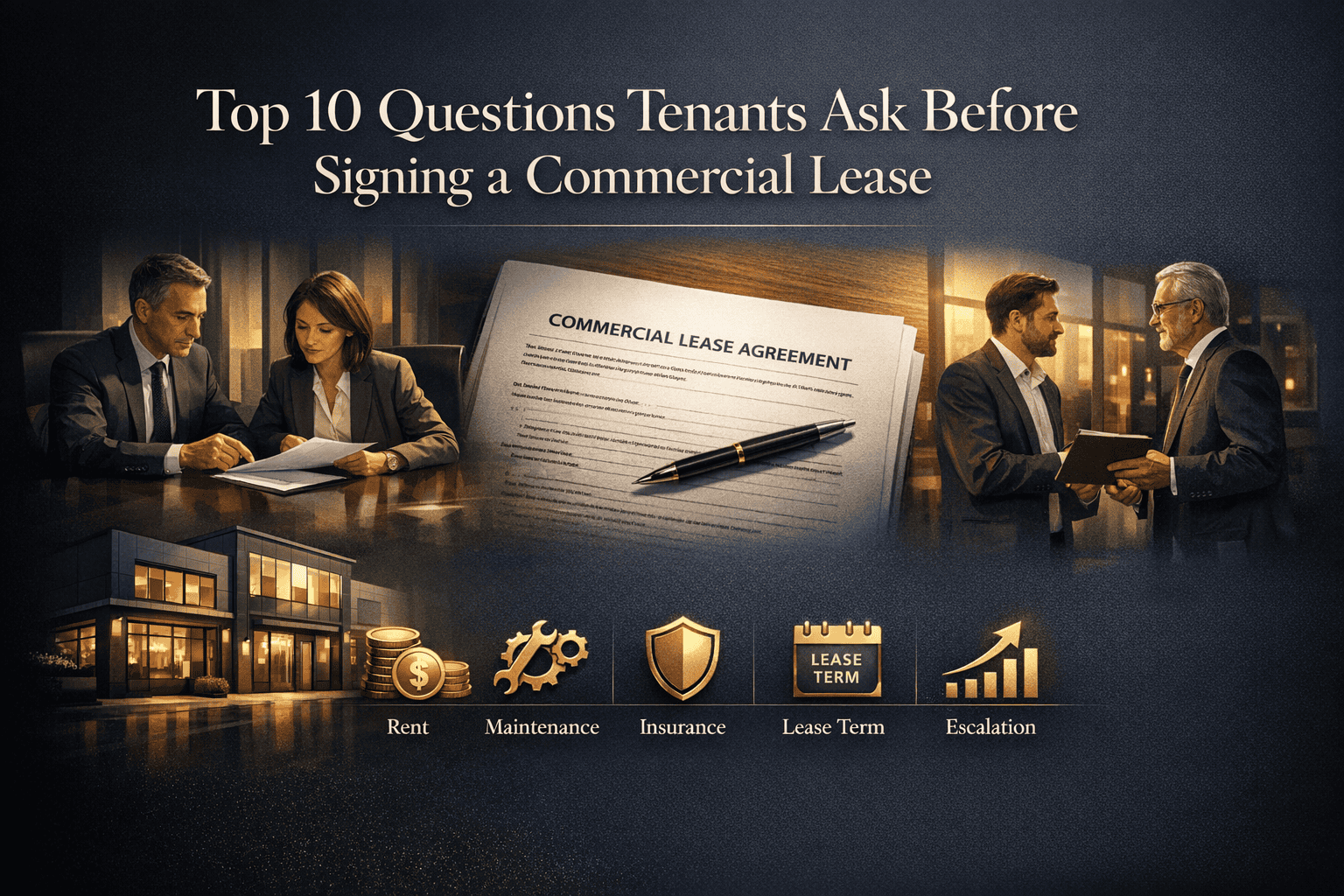
Top 10 Questions Tenants Ask Before Signing a Commercial Lease
Signing a commercial lease is one of the most significant financial commitments a business owner can make. Whether you're opening your first storefront, expanding your office space, or relocating your warehouse operations, the terms locked into that lease will shape your business for years to come. At Cordura, we work with tenants across the US market every day, and we've seen firsthand how the right questions — asked before signing — can save thousands of dollars and prevent costly surprises.
To help you navigate this process with confidence, we've compiled the top 10 questions tenants ask before signing a commercial lease, along with expert guidance on what to look for in each answer.
1. What Type of Commercial Lease Is This?
Not all commercial leases are structured the same way. Before anything else, tenants need to understand whether they're looking at a gross lease, net lease, modified gross lease, or a triple-net (NNN) lease. Each structure determines how operating expenses — including property taxes, insurance, and maintenance — are divided between the landlord and tenant.
- Gross Lease: Tenant pays a flat rent; landlord covers most operating costs.
- Net Lease: Tenant pays base rent plus some portion of operating expenses.
- Triple-Net (NNN) Lease: Tenant assumes responsibility for taxes, insurance, and maintenance in addition to base rent.
- Modified Gross Lease: A hybrid arrangement negotiated between landlord and tenant.
Understanding the lease type is foundational to calculating your true monthly cost. Explore our guide to commercial lease types for a deeper breakdown of each structure.
2. What Is Included in the Base Rent?
Tenants often focus on the headline rent figure, but the real cost of occupancy includes many additional line items. Always ask what is — and isn't — covered in your base rent. Common inclusions and exclusions vary by lease type and landlord, but you should clarify whether the following are covered:
- Property taxes and assessments
- Building insurance premiums
- Common area maintenance (CAM) fees
- Utilities such as water, electricity, and HVAC
- Janitorial services and landscaping
- Parking lot maintenance
CAM charges in particular can add 15–25% on top of your base rent in some commercial properties. Always request a detailed CAM reconciliation history from the landlord before signing.
3. How Long Is the Lease Term and What Are the Renewal Options?
Commercial lease terms typically range from 3 to 10 years, far longer than a standard residential lease. For tenants, this raises critical questions:
- What is the initial lease term?
- Are renewal options available, and at what rate?
- Is there a right of first refusal on the space if the building is sold?
- What happens if your business grows or downsizes — is there flexibility?
Negotiating a renewal option clause at a predetermined rent or a capped increase protects your business from market-rate hikes at renewal time. This is especially valuable in high-demand commercial corridors where rents can escalate dramatically over a multi-year term.
4. What Are the Rent Escalation Clauses?
Most commercial leases include provisions for rent increases over the lease term. These escalation clauses can be structured as:
- Fixed increases: A set dollar amount or percentage increase annually (e.g., 3% per year).
- CPI-linked increases: Rent adjusts based on the Consumer Price Index.
- Percentage rent: Common in retail leases — base rent plus a percentage of gross sales.
- Market-rate adjustments: Rent resets to prevailing market rates at renewal.
Understanding exactly how and when your rent will increase allows you to model your occupancy costs accurately over the full lease term. Always request a multi-year rent schedule in writing before signing.
5. Who Is Responsible for Repairs and Maintenance?
One of the most contentious areas in commercial leasing is the allocation of repair and maintenance responsibilities. Before signing, tenants should clearly understand who is responsible for:
- HVAC systems and mechanical equipment
- Roof and structural repairs
- Plumbing and electrical systems
- Interior improvements and fixtures
- Exterior and parking lot maintenance
In many NNN leases, tenants bear a substantial share of maintenance costs, including major systems like HVAC. Always request documentation on the age and condition of building systems — an aging HVAC unit can mean tens of thousands of dollars in unexpected costs. Learn more about commercial property due diligence to protect yourself before committing.
6. Can I Make Improvements or Modifications to the Space?
Most businesses need to customize a space to fit their operational needs. Whether you're building out a kitchen, installing specialized equipment, or simply repainting walls, you need written landlord approval and clear terms around:
- Tenant Improvement Allowance (TIA): Many landlords offer a TIA — a contribution toward build-out costs — especially in competitive markets. Negotiate this upfront.
- Alteration permissions: What changes require written consent? Are there restrictions on structural modifications?
- Restoration obligations: Will you be required to return the space to its original condition at lease end? This can be a significant hidden cost.
Get every approved modification documented in writing, including the agreed-upon restoration requirements, to avoid disputes when the lease terminates.
7. What Are the Terms for Early Termination?
Business conditions change — sometimes suddenly. A retail concept that works today may need to pivot, or a company may face unexpected financial hardship. Before signing a long-term lease, always ask:
- Is there an early termination clause in the lease?
- What is the penalty or "lease break fee" for exiting before the end of the term?
- Under what conditions can either party terminate the lease early?
- Is subletting or assignment of the lease allowed?
Early termination clauses — also called "kick-out clauses" — can provide critical protection. In some leases, a tenant may be permitted to exit if sales fall below a certain threshold, or after a minimum occupancy period. These provisions are negotiable and should be pursued proactively.
8. What Happens If the Building Is Sold?
This is a question many tenants overlook, but it's critically important. If the property changes ownership during your lease term, you need to understand:
- Does the lease transfer to the new owner (typically yes, under a "successor and assigns" clause)?
- Does the new owner have the right to terminate your lease?
- Do you have a right of first offer or right of first refusal to purchase the property if it goes up for sale?
- Are your security deposit and prepaid rents protected in a sale?
A Non-Disturbance Agreement (SNDA) — Subordination, Non-Disturbance, and Attornment agreement — protects tenants by ensuring their lease rights are honored even after a sale or lender foreclosure. Always request this protection when signing in a property with existing financing.
9. What Are the Insurance Requirements?
Commercial leases almost universally require tenants to carry specific insurance coverage. Before signing, clarify exactly what coverage is required, including:
- General liability insurance (typical minimums range from $1M to $2M per occurrence)
- Property insurance on tenant-owned improvements and business personal property
- Business interruption insurance
- Workers' compensation coverage
- Umbrella or excess liability policies
Review these requirements with your insurance broker before signing to confirm you can meet them and to budget accurately. Some landlords also require themselves to be listed as an "additional insured" on your policy — a standard but important detail to flag for your insurer.
10. What Are the Exclusivity and Use Clauses?
For retail and food-service tenants especially, exclusivity provisions can make or break a location's value. An exclusivity clause prevents the landlord from leasing space in the same property or complex to a direct competitor. Before signing, ask:
- Does the lease include an exclusivity clause protecting your business category?
- How broadly or narrowly is your permitted use defined?
- Are there restrictions on what products or services you can offer?
- What happens if you want to expand or change your business model during the lease term?
A poorly drafted use clause can prevent you from adapting your business concept, while an overly broad exclusivity clause may be unenforceable. Work with a commercial real estate attorney to ensure the language protects your interests without creating unnecessary operational constraints.
Bonus Tips: Before You Sign Any Commercial Lease
Beyond the top 10 questions above, experienced tenants and commercial real estate advisors recommend the following best practices before executing any lease agreement:
- Hire a commercial tenant representative: A tenant rep broker works exclusively in your interest and is typically paid by the landlord — making it a cost-neutral decision that often results in significantly better lease terms.
- Engage a commercial real estate attorney: Lease language is complex and often landlord-favorable. An attorney can identify hidden risks and negotiate protective provisions.
- Conduct thorough due diligence on the property: Inspect the building's systems, review zoning compliance, and confirm permitted use before committing.
- Understand the local market: Knowing current market rents and vacancy rates gives you powerful negotiating leverage.
- Get everything in writing: Verbal promises from landlords are unenforceable. Every concession, modification, and agreement must be documented in the lease or a signed addendum.
How Cordura Can Help You Lease Smarter
At Cordura, we specialize in helping businesses across the US find, evaluate, and negotiate commercial spaces that align with their goals and budget. Whether you're a first-time commercial tenant or an experienced business owner expanding into new markets, our team brings the local market expertise and transaction experience you need to secure the right space on the right terms.
From office suites and retail storefronts to industrial warehouses and mixed-use properties, Cordura's platform connects tenants with quality commercial listings and expert advisory support throughout the leasing process. Browse available commercial spaces near you and take the first step toward your next business location today.
Don't let a poorly understood lease become a liability. Arm yourself with the right questions, the right advisors, and the right partner — and sign with confidence.