
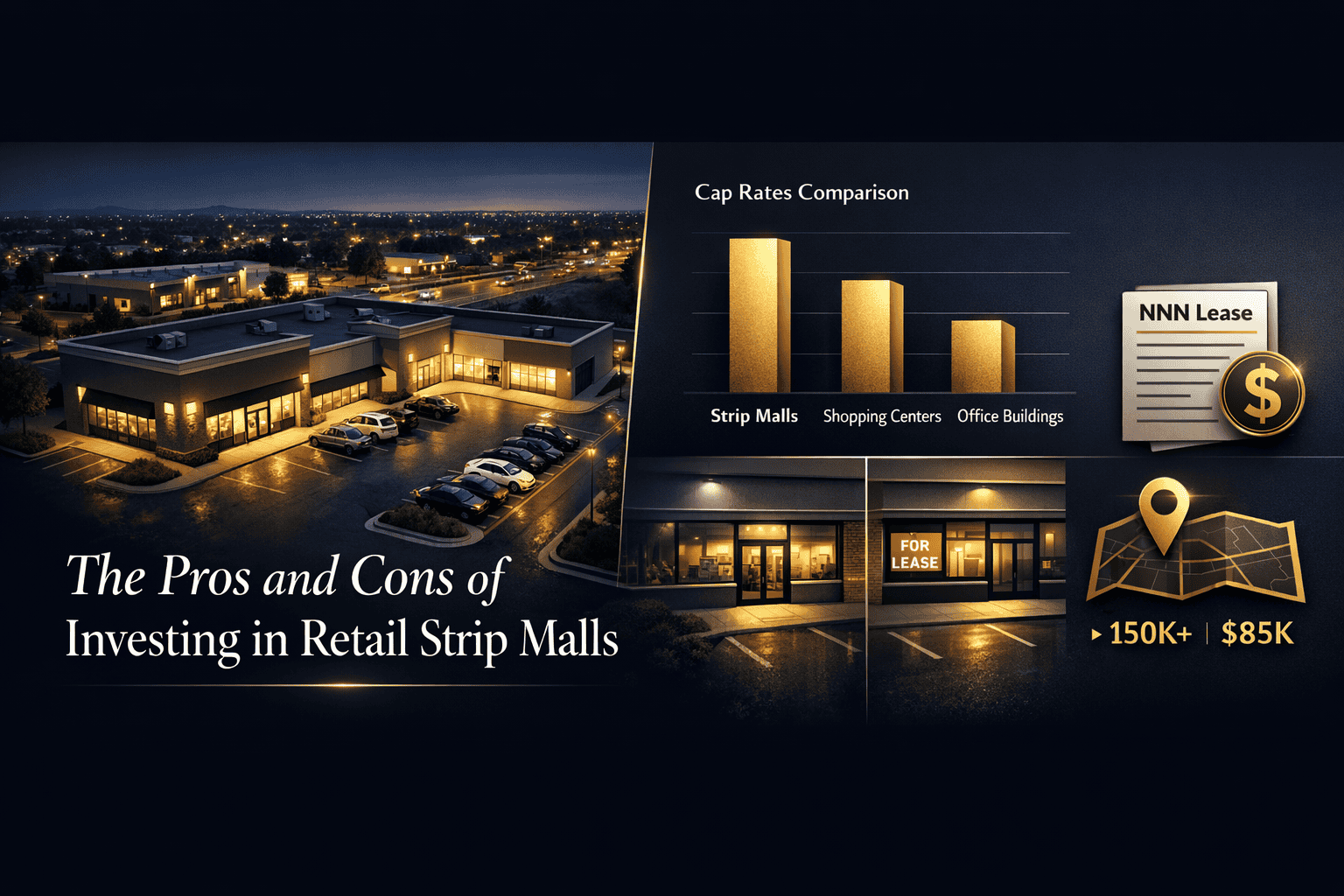
The Pros and Cons of Investing in Retail Strip Malls
Retail strip malls have long been a staple of the American commercial real estate landscape. From neighborhood grocery anchors to local service corridors, these open-air retail centers offer investors a unique blend of accessibility, income potential, and manageable complexity. But like any investment, they come with their share of risks and rewards. Whether you're a seasoned investor or just beginning to explore commercial real estate investing, understanding the full picture is essential before committing capital to a strip mall property.
What Is a Retail Strip Mall?
A retail strip mall — also called a strip center or inline retail center — is a row of retail storefronts that typically share a common parking lot and are accessible from the street. Unlike enclosed shopping malls, strip malls are open-air and usually feature a mix of tenants such as restaurants, salons, dry cleaners, convenience stores, and service-based businesses. They range in size from small neighborhood centers with 3–5 tenants to larger community centers anchored by a grocery store or pharmacy.
Strip malls are one of the most common forms of retail real estate in the United States, with tens of thousands of properties spread across urban, suburban, and rural markets. Their ubiquity makes them a familiar — and often attractive — entry point for commercial real estate investors.
The Pros of Investing in Retail Strip Malls
1. Consistent Cash Flow Potential
One of the most appealing aspects of strip mall investing is the potential for steady, recurring income. With multiple tenants paying monthly rent, your cash flow is diversified across several leases. Even if one tenant vacates, you still have income coming in from the others — a significant advantage over single-tenant properties where a vacancy means zero rental income.
Many strip mall leases are structured as triple net (NNN) leases, meaning tenants are responsible for property taxes, insurance, and maintenance costs in addition to base rent. This structure can dramatically reduce the landlord's operating expenses and increase net operating income (NOI).
2. Lower Barrier to Entry Compared to Large Retail Centers
Compared to regional malls or large lifestyle centers, strip malls typically require less capital to acquire and manage. Smaller strip centers can often be purchased for $1 million to $5 million, making them accessible to individual investors and smaller investment groups. This lower price point allows new investors to gain exposure to commercial real estate without the complexity and capital requirements of larger assets.
3. Strong Demand for Necessity-Based Tenants
Strip malls anchored by or featuring necessity-based tenants — think grocery stores, pharmacies, urgent care clinics, nail salons, and quick-service restaurants — have shown remarkable resilience even during economic downturns. These businesses serve everyday consumer needs and are less susceptible to the e-commerce disruption that has plagued traditional retail categories like apparel and electronics.
The COVID-19 pandemic reinforced this trend, as service-oriented and convenience-based tenants continued to draw foot traffic while experiential and soft goods retailers struggled. Investors who focus on necessity-anchored strip centers have historically enjoyed higher occupancy rates and more durable income streams.
4. Value-Add Opportunities
Strip malls often present compelling value-add investment opportunities. A property with below-market rents, high vacancy, or deferred maintenance can be acquired at a discount and repositioned through renovations, rebranding, or improved tenant mix. Savvy investors can create significant equity through active asset management — negotiating higher rents, attracting stronger tenants, and improving curb appeal to increase property value.
5. Appreciation and Equity Building
Like all real estate, well-located strip malls can appreciate in value over time. As surrounding areas develop, population grows, or retail demand increases, the underlying land and property values can rise. Investors also build equity through mortgage paydown and can leverage that equity for future acquisitions. Explore our commercial property listings to find value-add strip centers currently on the market.
6. Simpler Management Structure
Compared to multi-family residential properties, strip malls are often easier to manage from a day-to-day operations standpoint. With NNN leases, tenants handle much of the maintenance within their own spaces. Property management responsibilities are generally more predictable, and there are no late-night tenant calls about broken appliances or noise complaints.
The Cons of Investing in Retail Strip Malls
1. E-Commerce Disruption and Retail Headwinds
The rise of online shopping has fundamentally altered the retail landscape. Tenants in categories like apparel, books, electronics, and home goods have been hit hard by competition from Amazon and other e-commerce platforms. Vacant storefronts in strip malls are increasingly difficult to fill with traditional retailers, forcing landlords to rethink their tenant mix and adapt to a new retail paradigm.
While necessity-based tenants have proven more resilient, investors must remain vigilant about the types of businesses filling their spaces. A strip mall heavily reliant on soft goods retailers carries significantly more risk than one anchored by a grocery store or medical clinic.
2. Vacancy Risk and Tenant Turnover
Retail businesses have historically high failure rates, particularly among small, independent operators. When a tenant closes — whether due to bankruptcy, lease expiration, or poor performance — finding a replacement can take months or even years. During that vacancy period, the landlord absorbs the carrying costs of the empty space, including property taxes, insurance, and common area maintenance.
Vacancy risk is especially pronounced in secondary and tertiary markets where demand for retail space is lower and the pool of prospective tenants is smaller. Investors must carefully underwrite vacancy assumptions and maintain adequate cash reserves to weather tenant turnover.
3. Interest Rate Sensitivity
Like all income-producing real estate, strip mall valuations are closely tied to interest rates. Rising interest rates increase borrowing costs and compress cap rates, which can reduce property values and make refinancing more expensive. Investors who acquired properties with short-term floating-rate debt during periods of low interest rates have faced significant challenges as rates climbed in recent years.
Careful attention to financing structure — including fixed vs. variable rates and loan maturity timelines — is critical to managing interest rate risk in a strip mall investment.
4. Capital Expenditure Requirements
Strip malls require ongoing capital investment to remain competitive. Roofs, parking lots, HVAC systems, signage, and facades all have finite useful lives and eventually require replacement or significant repair. Older properties may also need substantial upgrades to attract modern tenants who expect contemporary build-outs and efficient layouts.
Investors must budget carefully for capital expenditures (CapEx) and factor these costs into their underwriting. Failing to account for deferred maintenance when acquiring a property can significantly erode investment returns.
5. Location Dependency
Strip mall performance is heavily influenced by location. A well-placed strip center on a high-traffic arterial road with strong demographics can command premium rents and enjoy low vacancy. A poorly located center on a declining corridor or in a market with shrinking population can struggle to attract and retain quality tenants regardless of how well the property is managed.
Traffic counts, visibility, ingress/egress, co-tenancy, and surrounding demographics are all critical factors that must be thoroughly analyzed before investment. Location missteps are difficult and expensive to correct after acquisition.
6. Anchor Tenant Risk
Many strip malls depend on an anchor tenant — typically a grocery store, pharmacy, or discount retailer — to drive foot traffic to the center. When an anchor tenant closes or downsizes, the impact on the entire center can be severe. Smaller inline tenants who relied on the anchor's traffic draw may struggle, and the vacancy left by the anchor is often difficult and costly to fill.
Investors should carefully evaluate anchor tenant financial health, lease term remaining, and any co-tenancy clauses in inline leases that may allow tenants to reduce rent or terminate their leases if the anchor vacates.
7. Zoning and Regulatory Complexity
Commercial real estate investments are subject to local zoning ordinances, building codes, ADA compliance requirements, and environmental regulations. Changes in local zoning can affect permitted uses, expansion potential, and property values. Investors must conduct thorough due diligence on regulatory matters and work with qualified legal and environmental professionals before closing any transaction.
Key Metrics to Evaluate Before Investing
- Cap Rate: The ratio of net operating income to purchase price. Higher cap rates generally indicate higher risk or lower-quality assets.
- Net Operating Income (NOI): Total rental income minus operating expenses. The foundation of any income property valuation.
- Occupancy Rate: The percentage of leasable space currently rented. Industry benchmarks and local market data provide useful context.
- Weighted Average Lease Term (WALT): The average remaining lease duration across all tenants, weighted by square footage or income. Longer WALT indicates more income stability.
- Tenant Quality and Mix: Credit ratings, business type, and tenure of existing tenants significantly impact risk profile.
- Traffic Counts and Demographics: Vehicles per day, household income levels, population density, and growth trends in the trade area.
- Debt Service Coverage Ratio (DSCR): NOI divided by annual debt service. Lenders typically require a minimum DSCR of 1.25x.
Who Should Consider Investing in Strip Malls?
Strip mall investments are generally best suited for investors who have some familiarity with commercial real estate, understand the nuances of retail leasing, and have the patience to manage through tenant turnover and market cycles. They can be excellent portfolio diversifiers for investors already active in residential real estate who want to expand into commercial properties.
Investors who prefer passive income may want to consider net-leased strip centers with long-term, creditworthy tenants, while those with active management capabilities and a higher risk tolerance might pursue value-add opportunities in underperforming centers. Either way, partnering with experienced commercial real estate advisors who know your target market is invaluable.
At Cordura, we work with investors across the spectrum — from first-time commercial buyers to seasoned portfolio managers — to identify, evaluate, and acquire retail properties that align with their investment goals. Learn more about how we support investors through our investor resources page.
Final Thoughts: Is a Strip Mall a Good Investment?
The answer, as with most real estate questions, is: it depends. Strip malls can be excellent investments when acquired at the right price, in the right location, with the right tenant mix. They offer diversified income, manageable operations, and real upside through value-add strategies. But they also carry meaningful risks — from e-commerce disruption and anchor tenant exposure to interest rate sensitivity and location dependency.
The most successful strip mall investors are those who conduct rigorous due diligence, underwrite conservatively, maintain adequate reserves, and stay actively engaged with their properties and tenants. If you're considering adding a retail strip center to your portfolio, Cordura is here to help you navigate every step of the process — from market research and property identification to negotiation and closing.