
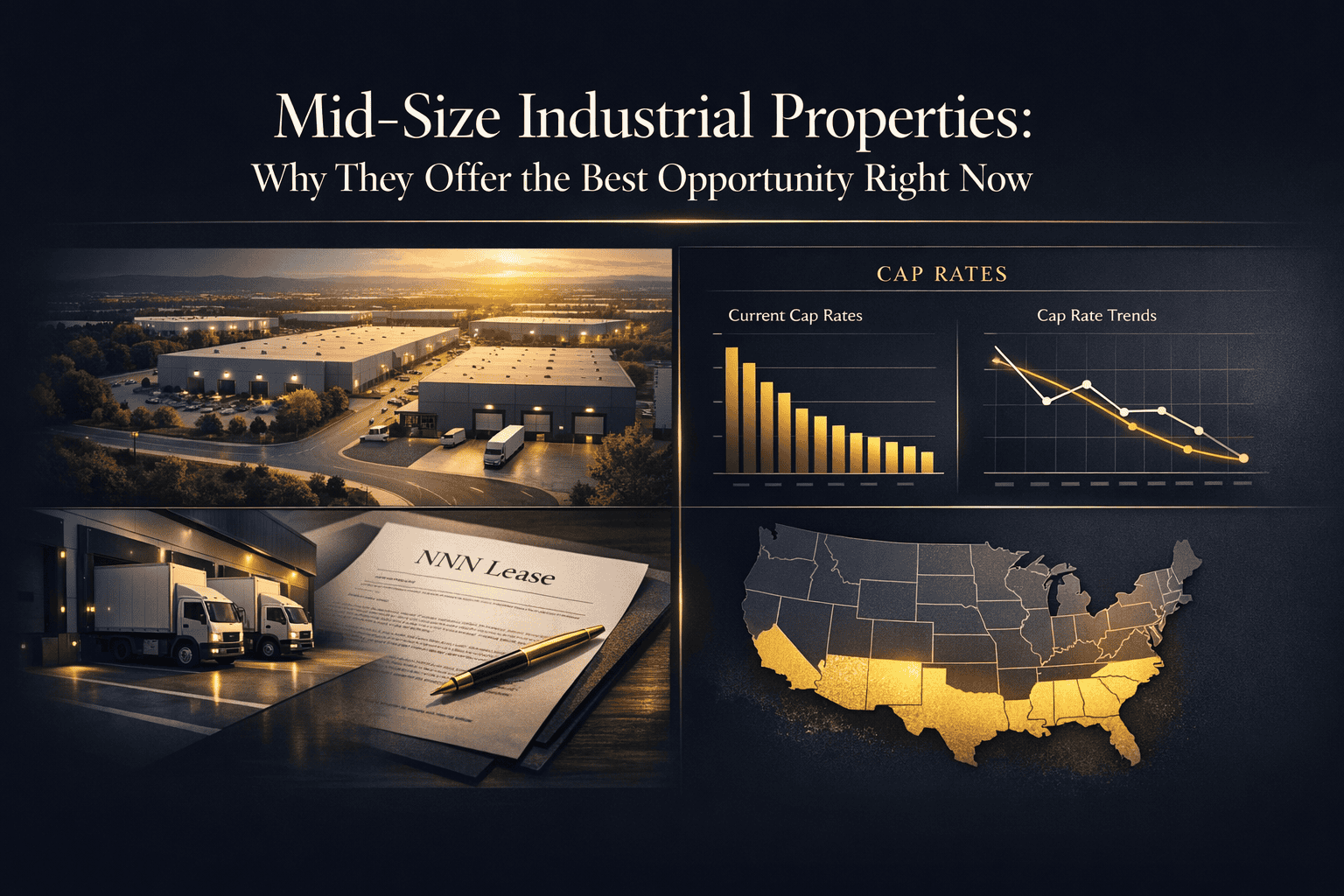
Mid-Size Industrial Properties: Why They Offer the Best Opportunity Right Now
In today's commercial real estate landscape, savvy investors are increasingly turning their attention to a segment that quietly outperforms many of its counterparts: mid-size industrial properties. Ranging roughly from 20,000 to 150,000 square feet, these assets sit in a sweet spot that large institutional players often overlook and small-cap investors can't always afford. The result? A compelling opportunity window that smart capital is beginning to recognize.
At Cordura, we work with investors and property seekers across the US market every day, and the conversation around mid-size industrial has never been more energized. Here's why this asset class deserves a serious look right now.
What Defines a Mid-Size Industrial Property?
Mid-size industrial properties typically fall between the small flex spaces favored by local businesses and the massive distribution mega-centers dominated by national REITs and institutional funds. Key characteristics include:
- Size range: 20,000 to 150,000 square feet
- Clear heights: 18 to 32 feet, suitable for light manufacturing, last-mile logistics, and e-commerce fulfillment
- Loading infrastructure: Dock-high and grade-level doors accommodating diverse tenant needs
- Location profile: Often situated in infill suburban corridors or secondary markets with strong population growth
- Tenant mix: Regional distributors, specialty manufacturers, third-party logistics (3PL) providers, and growing e-commerce operators
This profile makes them incredibly versatile — a trait that directly translates into lower vacancy risk and stronger rent growth.
The Market Forces Driving Demand
E-Commerce and Last-Mile Logistics
The explosive growth of online retail has fundamentally reshaped industrial real estate demand. While headlines focus on Amazon's massive fulfillment centers, the real story is the last-mile logistics revolution happening at the mid-size level. Retailers and logistics companies need strategically located distribution nodes closer to end consumers, and mid-size industrial facilities in suburban infill locations are perfectly positioned to serve this need. Vacancy rates in this segment have remained historically low, often below 4% in major metro areas, even as broader commercial real estate faces headwinds.
Nearshoring and Manufacturing Reshoring
Geopolitical pressures and supply chain vulnerabilities exposed during the pandemic have accelerated a powerful trend: US companies are bringing manufacturing and warehousing operations back stateside. This nearshoring wave is creating sustained demand for functional industrial space, particularly in secondary markets with lower land costs and available labor. Mid-size facilities are often the first to benefit because they match the footprint requirements of regional manufacturers and assembly operations that don't need a million square feet but need more than a small flex suite.
Supply Constraints in Infill Markets
One of the most powerful tailwinds for mid-size industrial is the structural supply constraint in high-demand infill submarkets. Land is scarce, entitlement timelines are long, and construction costs remain elevated. This means that well-located existing mid-size industrial stock is genuinely difficult to replace — a dynamic that supports both occupancy and rent growth for current owners. If you're interested in understanding how supply dynamics affect different property types, explore our industrial real estate investing resources for deeper market analysis.
Why Institutional Capital Leaves This Segment Open
Large pension funds, sovereign wealth vehicles, and major REITs have minimum check sizes that typically push them toward assets priced above $30 to $50 million. A mid-size industrial building in a growing secondary market might trade between $5 million and $25 million — below the threshold where institutional buyers compete aggressively. This creates a favorable dynamic for individual investors, family offices, and regional operators who can move nimbly and negotiate directly with motivated sellers.
Additionally, mid-size industrial properties often require more hands-on asset management — tenant relationship building, proactive maintenance, lease optimization — which institutional platforms are less equipped to deliver at this scale. This means locally-connected operators with market knowledge genuinely have a competitive advantage.
Financial Performance: The Numbers Behind the Opportunity
Cap Rates and Cash Flow
Mid-size industrial properties have historically offered cap rates in the 5.5% to 7.5% range depending on market, quality, and lease structure — often outperforming comparable office or retail assets on a risk-adjusted basis. Triple-net (NNN) lease structures are common in industrial, meaning tenants pay property taxes, insurance, and maintenance costs, which dramatically reduces landlord expense exposure and creates highly predictable cash flows.
Rent Growth Trajectory
Industrial rents across the US have seen significant appreciation over the past several years, and mid-size properties in supply-constrained submarkets have participated fully in this growth. Markets like the Inland Empire, Dallas-Fort Worth, Nashville, Columbus, and Phoenix have seen industrial asking rents climb 20% to 40% over three-year periods. Tenants rolling off below-market leases represent a significant mark-to-market opportunity for investors acquiring assets today.
Financing Landscape
While higher interest rates have pressured valuations across commercial real estate broadly, industrial — and mid-size industrial specifically — has held up better than most sectors because of its strong fundamentals. Lenders remain active in the space, and for well-located, stabilized assets with quality tenants, debt terms remain accessible. For investors who can deploy equity efficiently or structure creative financing, the current environment actually presents a compelling entry point as some sellers have adjusted pricing expectations.
Identifying the Right Markets
Not all mid-size industrial markets are created equal. The best opportunities tend to cluster around several key characteristics:
- Population growth corridors: Sun Belt metros and their surrounding suburbs continue to attract both residents and business activity, driving sustained industrial demand
- Interstate and port access: Proximity to major logistics infrastructure is a fundamental driver of industrial tenant demand and long-term asset value
- Labor availability: Markets with available blue-collar and light manufacturing labor pools attract the tenants who occupy mid-size industrial space
- Low existing vacancy: Submarkets with sub-5% vacancy are healthiest for rent growth and leasing velocity
- Limited new supply pipeline: Markets where land constraints or regulatory environments limit new construction protect existing owners from competitive new product
Secondary markets like Indianapolis, Kansas City, Salt Lake City, and Raleigh-Durham are increasingly on investors' radars because they check many of these boxes while offering more attractive entry pricing than gateway coastal markets.
Tenant Quality and Lease Structure Considerations
The strength of a mid-size industrial investment is heavily influenced by tenant quality and lease structure. Key factors to evaluate include:
- Tenant credit profile: Regional operators may not carry investment-grade ratings, but business stability, revenue history, and industry positioning matter enormously
- Lease term and rollover schedule: Longer weighted average lease terms (WALT) provide income visibility and reduce re-leasing risk
- Rent bumps: Annual escalations of 2% to 3% are common in industrial leases and compound meaningfully over a 5 to 10-year hold
- Renewal options and termination clauses: Understanding tenant rights within the lease is critical to projecting cash flows and exit timing
- Build-out and improvement requirements: Mid-size industrial tenants often request functional improvements like additional dock doors, office buildouts, or power upgrades — understanding what's required is key to underwriting accurately
Value-Add Opportunities in Mid-Size Industrial
One of the most attractive features of mid-size industrial investing is the range of value-add strategies available to operators who know what to look for. Common opportunities include:
- Acquiring below-market leased assets and capturing rent growth at lease rollover
- Upgrading older facilities with modern power, HVAC, and dock equipment to attract higher-quality tenants
- Repositioning functionally obsolete properties with enhanced clear heights or additional dock access
- Adding outdoor storage or yard space — a feature in extremely high demand from logistics and contractor tenants
- Subdividing or combining spaces to match current tenant demand profiles
These strategies allow skilled operators to manufacture equity rather than simply relying on market appreciation — a significant advantage in a higher rate environment. Our team at Cordura regularly helps investors identify these value-add plays across US markets. To learn more about evaluating commercial properties for value-add potential, visit our commercial real estate investment strategies guide.
Risks to Understand and Manage
No investment is without risk, and mid-size industrial is no exception. Key risk factors to monitor include:
- Single-tenant concentration: Many mid-size industrial assets have one or two tenants, creating income concentration risk if a tenant vacates
- Functional obsolescence: Older buildings with low clear heights or inadequate power may struggle to attract modern tenants
- Market softening: While industrial fundamentals are strong broadly, individual submarkets can experience localized softening if a major employer exits or new supply is delivered
- Environmental liability: Industrial properties carry higher environmental risk than other property types — thorough Phase I and Phase II environmental assessments are essential
- Capital expenditure surprises: Roof systems, dock equipment, and mechanical systems require ongoing investment — accurate reserves are critical to underwriting
Experienced sponsors and advisors help investors navigate these risks through thorough due diligence, conservative underwriting, and proactive asset management.
How to Access Mid-Size Industrial Deals
Sourcing quality mid-size industrial opportunities requires a combination of market presence, broker relationships, and off-market deal flow. Many of the best transactions never hit national listing platforms — they trade through local and regional broker networks, direct owner outreach, and word-of-mouth among active market participants.
This is precisely where working with a knowledgeable commercial real estate partner becomes critical. At Cordura, our team maintains active relationships across US industrial markets and can help investors identify, evaluate, and execute on mid-size industrial opportunities that match their investment criteria. Whether you're a first-time industrial buyer or an experienced operator looking to expand your portfolio, having the right market intelligence and deal access is the difference between capturing and missing this opportunity window.
Explore our current industrial properties for sale listings to see available mid-size industrial assets across key US markets.
The Bottom Line: Act Before the Window Narrows
Mid-size industrial properties represent one of the most compelling risk-adjusted opportunities in commercial real estate right now. Strong demand fundamentals, supply constraints, favorable lease structures, and a competitive landscape that favors nimble investors over institutional giants create a powerful combination. As interest rates eventually stabilize and more capital competes for quality industrial assets, today's entry points will look increasingly attractive in hindsight.
The investors who move thoughtfully and decisively in the next 12 to 24 months have the potential to build meaningful positions in an asset class with durable long-term demand drivers. The question isn't whether mid-size industrial is a good investment — the data makes that clear. The question is whether you're positioned to capitalize on it.
Ready to explore mid-size industrial opportunities? Contact the Cordura team today to discuss your investment goals and get access to our current deal pipeline across US markets.