Why Last-Mile Logistics Is Redefining Warehouse Demand
The rise of e-commerce and the growing expectation of same-day or next-day delivery have fundamentally transformed how goods move from origin to end consumer. At the heart of this transformation is last-mile logistics — the final leg of the delivery journey from a distribution hub to a customer's doorstep. This shift is not just reshaping supply chains; it is actively redefining warehouse demand across the United States, creating unprecedented opportunities for commercial real estate investors and property seekers alike.
What Is Last-Mile Logistics?
Last-mile logistics refers to the movement of goods from a transportation hub to the final delivery destination. Despite being the shortest segment of the supply chain, it is often the most complex, costly, and time-sensitive. According to industry research, last-mile delivery can account for up to 53% of total shipping costs, making it a focal point for retailers, logistics providers, and real estate developers.
As consumer expectations evolve — driven largely by Amazon, Walmart, and other retail giants — businesses are racing to position fulfillment infrastructure closer to dense population centers. This geographic urgency is the primary engine behind a dramatic surge in industrial real estate demand.
The E-Commerce Explosion and Its Impact on Industrial Real Estate
Online retail sales in the U.S. have grown exponentially over the past decade, accelerating sharply during and after the COVID-19 pandemic. Every $1 billion increase in e-commerce sales is estimated to require an additional 1.25 million square feet of warehouse space. When you multiply this across the scale of today's digital retail landscape, the numbers become staggering.
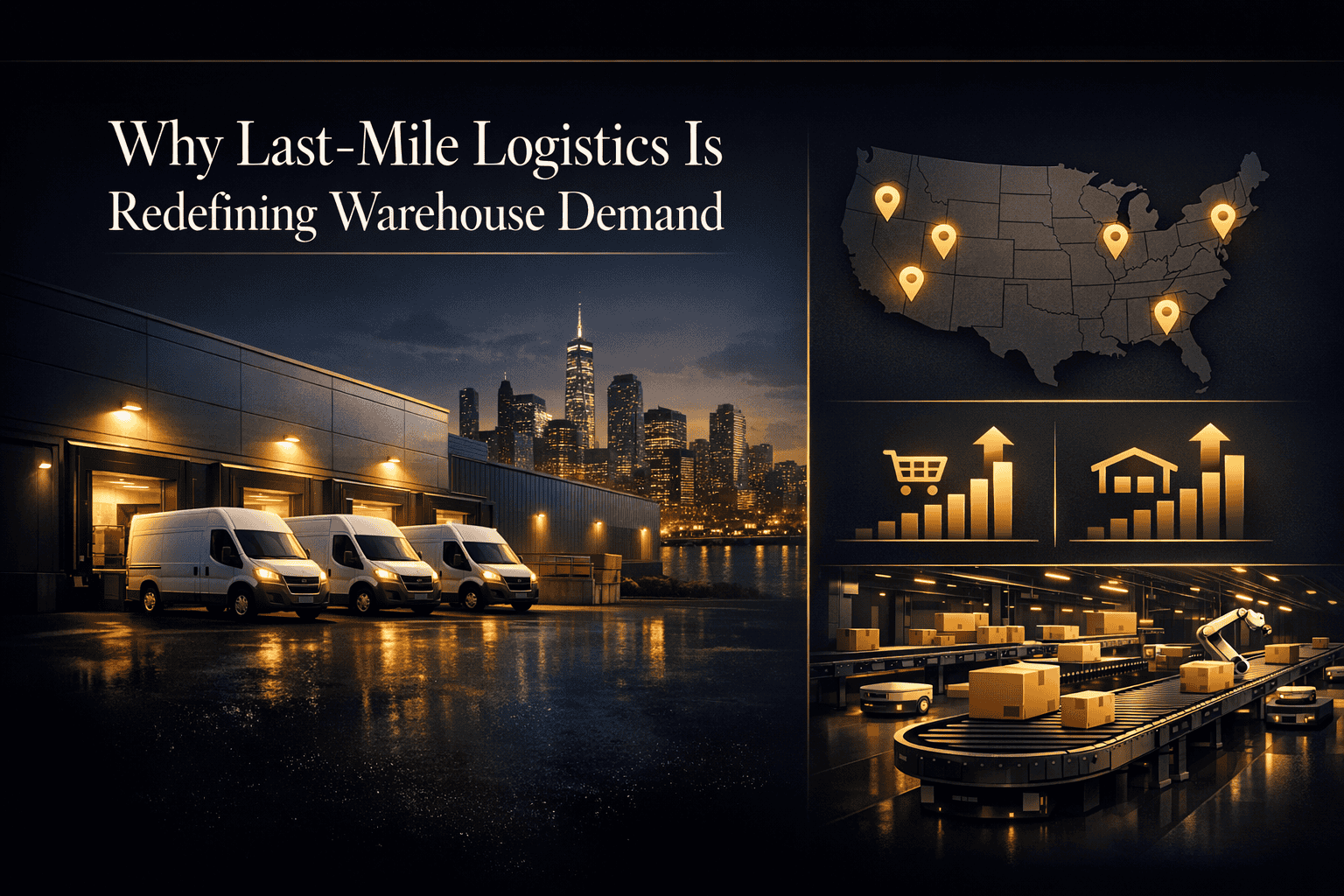
This demand has fueled record-low vacancy rates in industrial markets, particularly in urban and suburban corridors where proximity to consumers is paramount. Cities like Los Angeles, Dallas, Chicago, Atlanta, and New York are experiencing intense competition for last-mile warehouse space, pushing rents to historic highs and making industrial real estate investment one of the most compelling opportunities in commercial property today.
Urban Infill Warehousing: The New Frontier
Traditional warehouses were built in suburban or rural areas where land was cheap and plentiful. Last-mile logistics has flipped this model entirely. Today, the most valuable industrial assets are often located within city limits or in close proximity to urban cores — a trend known as urban infill warehousing.
These facilities are typically smaller in footprint than conventional distribution centers — ranging from 50,000 to 200,000 square feet — but they command premium rents due to their strategic location. Repurposed retail spaces, former big-box stores, underutilized parking structures, and even multi-story warehouse concepts are all being converted or developed to meet this growing need.
Key Characteristics of Last-Mile Warehouse Facilities
- Proximity to population centers: Located within 1–20 miles of dense residential areas to minimize delivery windows.
- Smaller footprints: Designed for speed and efficiency rather than massive inventory storage.
- Multi-tenant configurations: Often divided to serve multiple logistics operators simultaneously.
- Advanced technology integration: Robotics, AI-driven inventory systems, and automated sorting are common features.
- Enhanced loading infrastructure: Multiple dock doors and drive-in access to accommodate high delivery vehicle turnover.
Market Drivers Fueling Last-Mile Warehouse Demand
1. Consumer Delivery Expectations
The modern consumer expects fast, free, and reliable delivery. A 2023 survey found that over 60% of U.S. shoppers consider same-day or next-day delivery a significant factor in their purchasing decisions. Retailers that cannot meet this standard risk losing market share, pushing the entire logistics ecosystem to build closer to the customer.
2. The Growth of Third-Party Logistics (3PL) Providers
Third-party logistics companies such as XPO, Ryder, and GXO are expanding their last-mile networks aggressively. These operators require strategically located warehouse space and are signing long-term leases at premium rates, providing landlords with stable, credit-worthy tenants and strong income potential.
3. Retail Omnichannel Strategy
Brick-and-mortar retailers are increasingly using physical store locations and local warehouses as fulfillment hubs, blending in-store and online shopping experiences. This omnichannel approach means that even traditional retailers are entering the industrial real estate market, competing for last-mile facilities alongside pure e-commerce players.
4. Cold Chain and Grocery Delivery
The rapid growth of grocery delivery services — including Instacart, DoorDash, and Amazon Fresh — has created a parallel surge in demand for temperature-controlled last-mile facilities. Cold storage industrial assets are among the fastest-growing subsectors in commercial real estate, commanding significant rent premiums over standard dry warehouse space.
Geographic Hotspots for Last-Mile Warehouse Investment
Not all markets are created equal when it comes to last-mile logistics real estate. The most active investment and development activity is concentrated in markets with high population density, strong consumer spending, and robust infrastructure. Key U.S. markets to watch include:
- Inland Empire (California): The largest industrial market in the nation, serving as the primary gateway for West Coast imports.
- Dallas-Fort Worth (Texas): A central logistics hub benefiting from population growth and a business-friendly regulatory environment.
- New Jersey/New York Metro: Proximity to the densest consumer market in the U.S. drives extreme demand for infill industrial space.
- Atlanta (Georgia): A major Southeast distribution hub with access to major highway and rail networks.
- Chicago (Illinois): The Midwest's dominant logistics gateway with unmatched intermodal freight infrastructure.
For investors seeking exposure to these high-growth corridors, exploring commercial real estate listings in these regions can uncover compelling warehouse acquisition and leasing opportunities.
Investment Implications for Commercial Real Estate Stakeholders
The last-mile logistics trend presents a compelling case for industrial real estate as a core portfolio allocation for both institutional and private investors. Here's why:
Strong Rent Growth and Low Vacancy
Industrial vacancy rates in top U.S. markets have hovered near historic lows — often below 3-4% — while asking rents have climbed consistently. The supply-demand imbalance in urban infill markets is particularly acute, as zoning restrictions, land scarcity, and neighborhood opposition make new development challenging. This dynamic supports sustained rent growth and capital appreciation for existing asset holders.
Long-Term Lease Structures
Last-mile logistics operators typically sign leases of five to ten years or longer, particularly when they have invested in facility-specific technology and infrastructure. This provides investors with predictable, long-duration income streams that are increasingly attractive in uncertain economic environments.
Resilience Against Economic Cycles
While office and retail assets have faced significant headwinds from remote work and digital commerce trends, industrial real estate has demonstrated remarkable resilience. The structural tailwinds driving last-mile demand — e-commerce growth, urbanization, and changing consumer behavior — are long-term trends unlikely to reverse regardless of short-term economic fluctuations.
Challenges and Considerations for Last-Mile Warehouse Development
While the opportunity is significant, last-mile logistics real estate is not without its challenges. Investors and developers must navigate several key considerations:
- Zoning and permitting complexity: Urban infill development often faces resistance from local communities and complex municipal approval processes.
- Traffic and congestion concerns: High delivery vehicle traffic can create friction with neighboring businesses and residents, requiring careful site selection and operational planning.
- Higher land and construction costs: Urban land commands premium prices, compressing development margins and requiring disciplined underwriting.
- Sustainability requirements: Growing regulatory pressure around emissions and energy efficiency means developers must integrate EV charging infrastructure, solar panels, and green building certifications into new projects.
The Future of Last-Mile Logistics and Warehouse Real Estate
Looking ahead, several emerging technologies and trends are likely to further reshape last-mile logistics and its impact on warehouse demand:
Autonomous Delivery and Drone Logistics
As autonomous vehicles and drone delivery move from pilot programs to commercial deployment, the geographic requirements for last-mile facilities may evolve. Smaller, highly automated micro-fulfillment centers located even closer to residential neighborhoods could become the norm, creating an entirely new category of industrial real estate.
Micro-Fulfillment Centers
Retailers and logistics operators are experimenting with compact, highly automated fulfillment nodes embedded within grocery stores, strip malls, and urban retail environments. These micro-fulfillment centers represent a convergence of retail and industrial real estate that will create new investment and development models.
Data-Driven Site Selection
Advanced analytics, AI, and demographic data are increasingly driving warehouse location decisions. Investors and developers who leverage data-driven insights to identify emerging last-mile corridors before the market fully prices in the opportunity will be well-positioned to generate outsized returns.
For those looking to understand how industrial demand intersects with broader market dynamics, our resources on warehouse and distribution centers provide in-depth market analysis and property search tools tailored to the U.S. commercial real estate landscape.
Conclusion: Last-Mile Logistics as a Commercial Real Estate Catalyst
Last-mile logistics is no longer a niche concept confined to logistics textbooks — it is one of the most powerful demand drivers in the U.S. commercial real estate market today. From urban infill warehouses to cold storage facilities and micro-fulfillment centers, the need to get goods closer to consumers faster is reshaping the industrial landscape at an extraordinary pace.
For investors, buyers, and property seekers, understanding this trend is essential to making informed decisions in today's industrial market. Whether you are acquiring a distribution asset in a major metro corridor or evaluating a value-add warehouse opportunity in an emerging logistics hub, last-mile demand will continue to underpin strong fundamentals for years to come. Cordura is here to help you navigate this dynamic landscape with confidence, connecting you to the properties and insights that matter most in the evolving world of commercial real estate.