
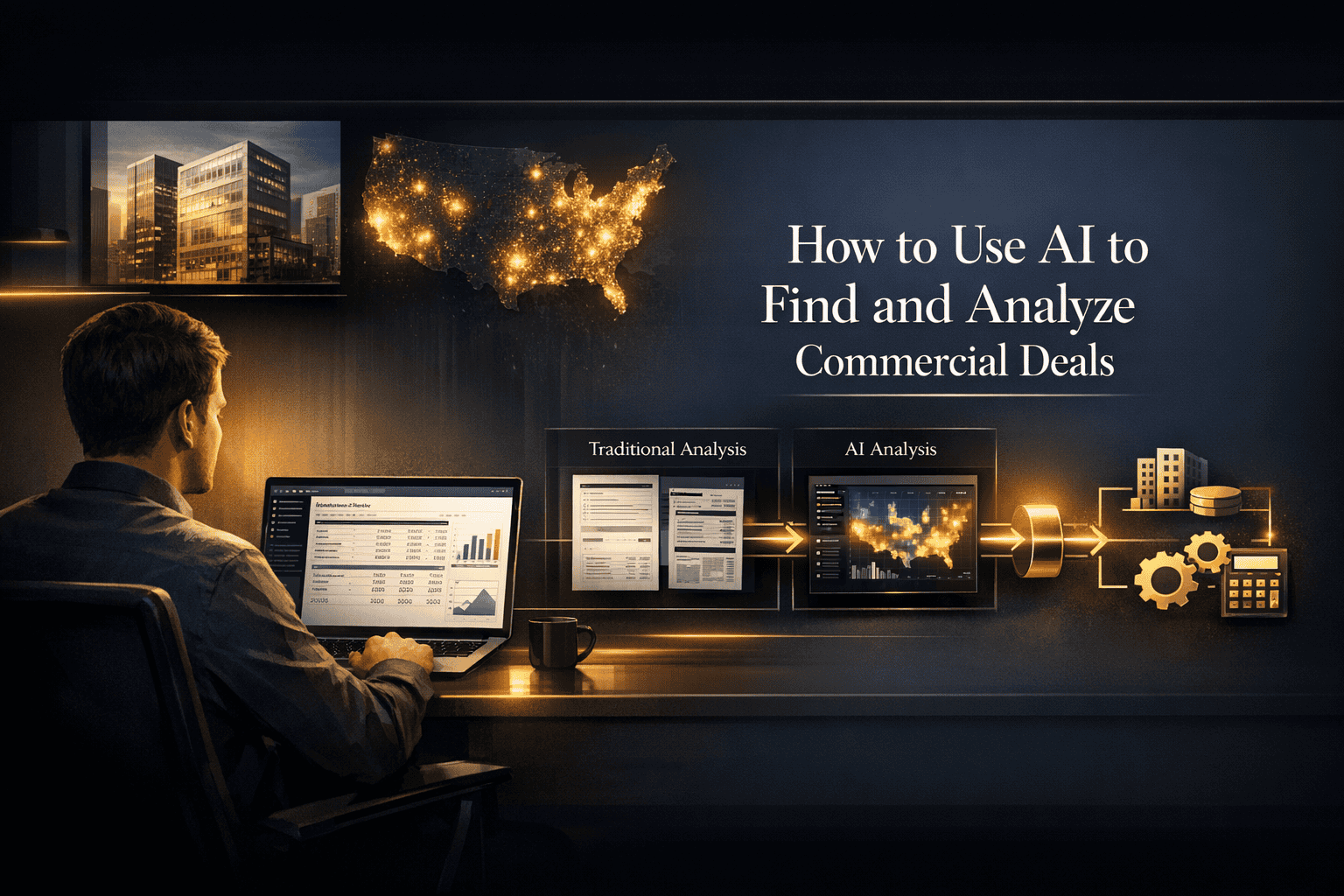
How to Use AI to Find and Analyze Commercial Real Estate Deals
The commercial real estate landscape is evolving faster than ever, and artificial intelligence is at the center of that transformation. Whether you're a seasoned investor or exploring your first commercial acquisition, AI-powered tools are reshaping how deals are discovered, evaluated, and closed. At Cordura, we help investors navigate this new frontier with confidence. In this guide, we'll break down exactly how to leverage AI at every stage of the commercial deal pipeline.
Why AI Is a Game-Changer for Commercial Real Estate Investors
Traditional deal sourcing relied on broker relationships, cold calls, and manual market research — processes that were slow, expensive, and often incomplete. AI changes the equation entirely. By processing millions of data points in seconds, AI tools can surface off-market opportunities, predict market trends, and flag undervalued properties long before they hit mainstream listing platforms.
For commercial investors, this means faster due diligence, sharper underwriting, and a measurable edge over competitors still relying on manual methods. According to industry data, investors using AI-driven platforms can reduce deal analysis time by up to 60%, allowing them to evaluate more opportunities and move faster when the right deal appears.
Step 1: Using AI for Smarter Deal Sourcing
The first challenge in commercial real estate is finding the right deals. AI platforms now aggregate data from public records, tax assessments, zoning databases, listing feeds, and even satellite imagery to identify properties that match your investment criteria before they're widely marketed.
Key AI Tools for Deal Sourcing
- PropStream and CoStar AI: Identify distressed properties, motivated sellers, and portfolio acquisition targets using predictive ownership scoring.
- Reonomy: Access deep ownership data and building characteristics across millions of commercial properties nationwide.
- CompStak: Leverage AI-curated lease comparables and sales data to identify submarkets with strong fundamentals.
- Natural Language Search Tools: Newer platforms allow you to search using plain English queries like "retail strip centers in Phoenix with below-market rents and a lease expiring within 18 months."
When setting up your AI search parameters, be as specific as possible. Define your target asset class, geography, price range, cap rate threshold, and value-add criteria. The more refined your inputs, the more relevant your deal flow will be.
Step 2: AI-Powered Market Analysis
Once you've identified a potential deal, the next step is understanding the market it sits in. AI tools excel at aggregating and interpreting macro and micro market data that would take a human analyst days to compile manually.
What AI Can Analyze in Minutes
- Local employment trends and population growth forecasts
- Historical rent growth and vacancy rate trajectories
- Competitive supply pipelines and absorption rates
- Foot traffic patterns (critical for retail and hospitality assets)
- Crime statistics, school ratings, and walkability scores
- Zoning changes and municipal development plans
Platforms like Placer.ai and Esri's Business Analyst use machine learning to model consumer behavior and demographic shifts that directly impact commercial property performance. For multifamily and mixed-use investors, these insights can be the difference between a winning acquisition and a costly misstep.
If you're still building your foundation in market evaluation, our guide on commercial real estate market analysis provides a strong starting framework to complement your AI toolkit.
Step 3: Automating Financial Underwriting with AI
Underwriting is where most deals are won or lost. AI doesn't replace sound judgment, but it dramatically accelerates and stress-tests your financial models. Modern AI underwriting tools can ingest rent rolls, operating statements, lease abstracts, and market comparables to produce detailed proformas in a fraction of the time traditional methods require.
AI Underwriting Capabilities to Look For
- Automated Rent Roll Analysis: Instantly summarize lease terms, expiration schedules, and tenant credit quality from uploaded documents.
- Scenario Modeling: Run best-case, base-case, and downside scenarios with variable assumptions for vacancy, rent growth, and exit cap rates.
- Comparable Sales Matching: AI identifies the most relevant comps based on asset type, size, vintage, and submarket without manual filtering.
- Debt Structuring Suggestions: Some platforms now recommend optimal loan structures based on your hold period, return targets, and current lending environment.
Tools like Argus AI, Dealpath, and Lev's AI mortgage platform are becoming standard in institutional workflows and are increasingly accessible to individual investors and smaller firms. Integrating these into your process ensures you're not leaving value on the table during due diligence.
Step 4: Using AI for Due Diligence and Risk Assessment
Beyond the numbers, AI is becoming a powerful ally in qualitative due diligence. Computer vision technology can analyze satellite and street-level imagery to assess property condition, identify deferred maintenance, and flag structural concerns before you ever set foot on site. Natural language processing (NLP) tools can review lease agreements, environmental reports, and title documents in minutes, highlighting key risk factors and non-standard clauses.
Due Diligence Tasks AI Can Accelerate
- Document review and lease abstraction
- Environmental risk flagging from Phase I reports
- Tenant credit analysis and bankruptcy risk scoring
- Property condition assessment from aerial imagery
- Title and encumbrance review
By automating the document-heavy aspects of due diligence, your team can focus on the strategic decisions that require human expertise — negotiation strategy, relationship management, and final investment judgment.
Step 5: Predicting Deal Outcomes with Predictive Analytics
One of the most powerful applications of AI in commercial real estate is predictive analytics — using historical data and machine learning models to forecast future property performance. These models consider hundreds of variables simultaneously, including interest rate trends, local economic indicators, tenant industry health, and comparable asset performance histories.
For example, an AI model might flag that a flex industrial property in a specific submarket has an 87% probability of achieving 8%+ annual rent growth over the next three years based on current supply constraints and e-commerce demand drivers. This kind of probabilistic thinking elevates your investment thesis from gut feeling to data-backed conviction.
Investors looking to build a diversified portfolio can pair predictive analytics with strategic asset allocation planning. Explore our resource on commercial real estate investment strategies to understand how data-driven insights translate into portfolio construction decisions.
Step 6: AI-Enhanced Deal Communication and CRM
Finding and analyzing deals is only part of the equation — you also need to manage relationships, track pipeline, and communicate efficiently. AI-powered CRM tools like Salesforce Einstein, HubSpot AI, and commercial-specific platforms like Buildout are transforming how brokers and investors manage their deal flow.
How AI Improves Deal Communication
- Automatically log and summarize broker calls and emails
- Prioritize follow-ups based on deal stage and probability scores
- Generate first-draft offering memoranda and investment summaries
- Identify relationship gaps with key brokers or owners in your target markets
By keeping your pipeline organized and your communications sharp, AI ensures that no opportunity falls through the cracks — a critical advantage in competitive markets where deals move in days, not weeks.
Common Mistakes to Avoid When Using AI in Commercial Real Estate
AI is powerful, but it's not infallible. Here are the most common pitfalls investors encounter when integrating AI into their deal process:
- Over-relying on outputs without validation: Always verify AI-generated data against primary sources. Models can reflect outdated or biased training data.
- Ignoring qualitative factors: AI struggles with nuance — neighborhood character, landlord reputation, and tenant relationships still require human assessment.
- Using too many tools simultaneously: Start with one or two platforms and master them before expanding your tech stack.
- Neglecting data privacy: Be mindful of what proprietary deal information you upload to third-party AI platforms.
- Treating AI as a replacement for expertise: The best results come from combining AI efficiency with experienced judgment, not substituting one for the other.
Building Your AI-Powered Commercial Real Estate Workflow
The most successful commercial investors treat AI as a force multiplier rather than a magic solution. A well-designed workflow might look like this:
- Sourcing: Run weekly AI-powered deal screens through Reonomy or PropStream based on defined acquisition criteria.
- Preliminary Analysis: Use AI market tools to assess submarket fundamentals in under 30 minutes per deal.
- Financial Modeling: Upload financials to an AI underwriting platform for automated proforma generation and scenario testing.
- Due Diligence: Deploy NLP tools for document review and computer vision for remote property assessment.
- Decision Making: Layer in predictive analytics to stress-test your investment thesis before final commitment.
As you refine this workflow, you'll find that AI dramatically increases the number of deals you can meaningfully evaluate — giving you a larger opportunity set without sacrificing analytical rigor.
For investors just getting started, our beginner's guide to commercial real estate investing covers the foundational concepts you'll want to pair with your AI-powered approach.
The Future of AI in Commercial Real Estate
We're still in the early innings of AI's impact on commercial real estate. Emerging capabilities like autonomous deal negotiation agents, real-time market sentiment analysis from social and news data, and AI-generated development feasibility studies are already in development at leading proptech firms. Investors who build AI literacy today will be best positioned to capitalize on these advancements as they mature.
At Cordura, we're committed to helping our clients stay ahead of the curve. Whether you're analyzing your first commercial deal or managing a multi-asset portfolio, leveraging AI is no longer optional — it's the new standard for competitive investors in the US commercial real estate market.
Ready to Find Your Next Commercial Deal?
The tools are available, the data is richer than ever, and the competitive advantage is real. Start integrating AI into your commercial real estate process today and discover how much faster, smarter, and more profitable your deal flow can become. Cordura is here to guide you every step of the way.