How to Negotiate a Commercial Lease Like a Pro
Signing a commercial lease is one of the most significant financial commitments a business owner or investor can make. Unlike residential leases, commercial agreements are complex, highly negotiable, and can bind you to terms for five, ten, or even twenty years. Knowing how to negotiate a commercial lease effectively can save you thousands of dollars annually and protect your business from unfavorable clauses that could cost you down the road.
At Cordura, we work with business owners, investors, and property seekers across the US market every day. This guide breaks down the professional strategies you need to walk into any lease negotiation with confidence — and walk out with a deal that works for you.
Understand the Types of Commercial Leases Before You Negotiate
Before you can negotiate effectively, you need to understand what type of lease is on the table. The structure of the lease fundamentally changes which terms matter most and where your leverage lies.
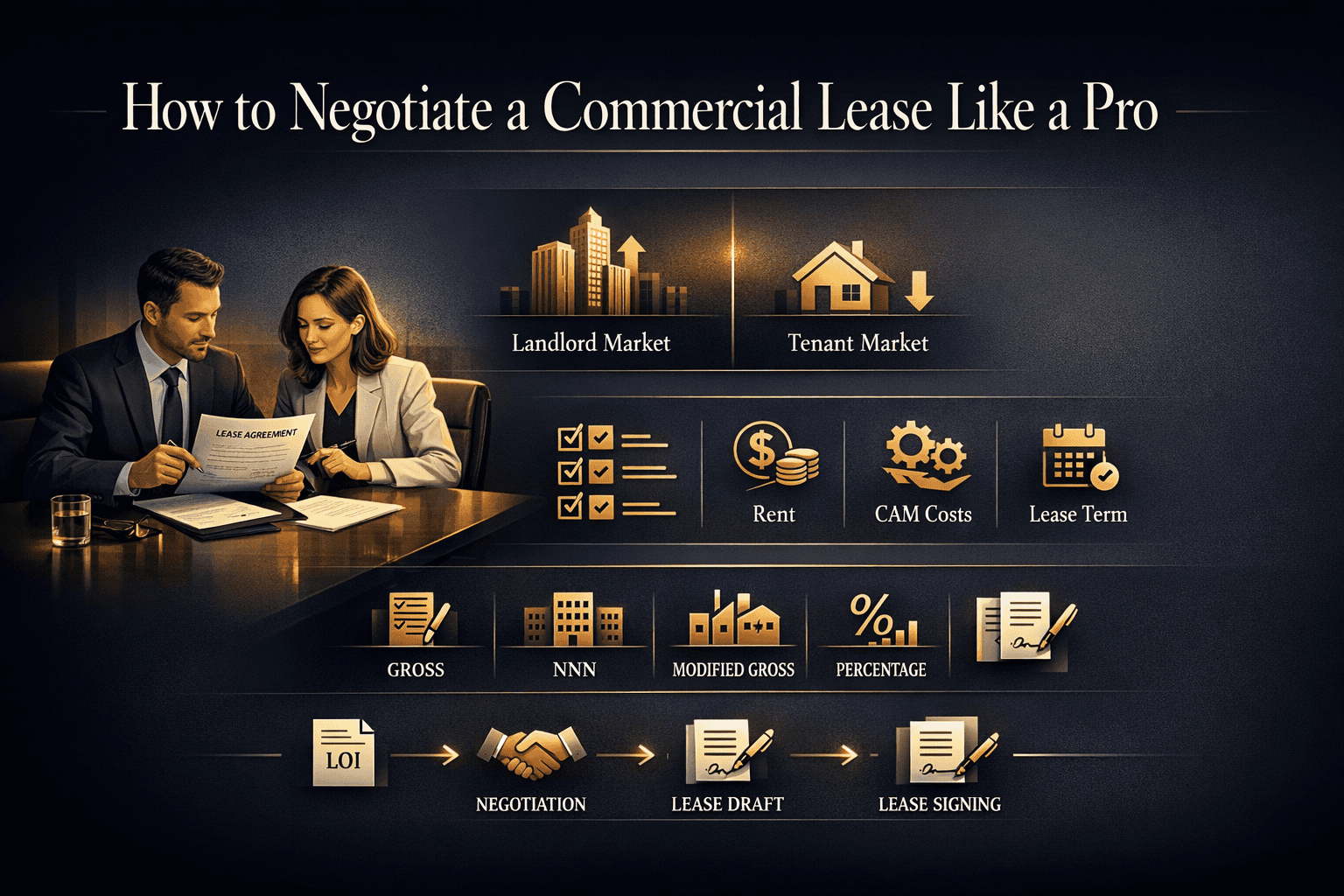
- Gross Lease: The landlord covers most property expenses (taxes, insurance, maintenance). You pay a fixed monthly rent.
- Net Lease (Single, Double, Triple): You share or fully cover operating expenses in addition to base rent. Triple Net (NNN) leases are common in retail and industrial properties.
- Modified Gross Lease: A hybrid where some expenses are split between landlord and tenant.
- Percentage Lease: Common in retail — base rent plus a percentage of your monthly gross sales.
Understanding the lease type helps you identify your total occupancy cost, not just the headline rent figure. Always calculate the all-in cost before comparing properties. For a deeper look at how lease structures affect investment returns, explore our commercial real estate investment guide.
Do Your Market Research First
Knowledge is your most powerful negotiating tool. Before sitting down with any landlord or broker, research comparable properties in the area — also known as "comps." Understanding the going market rate for similar square footage, location, and lease type gives you a credible baseline to reference during negotiations.
Key data points to gather include:
- Average asking rent per square foot in your target market
- Current vacancy rates in the submarket
- Average tenant improvement (TI) allowances being offered
- Typical lease lengths for comparable spaces
- Concessions landlords are currently offering (free rent periods, etc.)
High vacancy rates in a submarket are a signal that you have more negotiating power. Conversely, a tight market with low vacancy means landlords hold more leverage. Use this context to calibrate how aggressively you push on each term.
Hire a Tenant Representative Broker
One of the smartest moves you can make is hiring a tenant representative broker — a commercial real estate professional who works exclusively on your behalf. Unlike the landlord's listing broker, a tenant rep is legally and ethically obligated to represent your interests.
Critically, tenant rep brokers are typically compensated by the landlord (via a commission split from the listing broker's fee), which means their services often cost you nothing directly. They bring market intelligence, negotiation experience, and access to off-market opportunities that you simply cannot replicate on your own.
When selecting a tenant rep, look for someone who specializes in your property type — office, retail, industrial, or mixed-use — and who has recent transaction experience in your target submarket. Cordura's team connects business owners with trusted commercial real estate professionals across the US. Browse available commercial spaces to get started.
Key Lease Terms to Negotiate
Once you have your research and representation in place, it's time to focus on the specific terms. Here are the most impactful clauses to negotiate in any commercial lease:
1. Base Rent and Rent Escalations
The base rent is the obvious starting point, but equally important are the annual rent escalation clauses. Many leases include fixed annual increases (e.g., 3% per year) or CPI-linked (Consumer Price Index) adjustments. Negotiate the escalation rate down, cap it, or push for a fixed-step schedule that you can model accurately in your financial projections.
2. Lease Term and Renewal Options
Shorter initial terms reduce your exposure if the space doesn't work out — but longer terms can provide leverage for better rates and landlord concessions. Always negotiate renewal options with pre-agreed rent rates or formulas. A renewal option at "fair market value" gives you less certainty than one with a capped increase.
3. Tenant Improvement Allowance (TIA)
The tenant improvement allowance (TIA) is money the landlord provides to build out or renovate the space to suit your needs. This is often one of the most negotiable items — especially in a soft market. Push for a higher TIA, or negotiate for the landlord to complete specific improvements as a condition of signing.
4. Free Rent Period
It's common — and expected — to negotiate a free rent period (also called rent abatement) at the start of your lease. This gives you time to build out the space, onboard staff, and generate revenue before your full rent obligation begins. In competitive markets, you might secure one to three months free; in soft markets, six months or more is not unusual.
5. Operating Expense Caps
In net leases, you'll be responsible for a share of operating expenses. Negotiate a cap on controllable expense increases (typically 3-5% per year). This protects you from sudden spikes in costs like property management fees or common area maintenance (CAM) charges.
6. Permitted Use Clause
The permitted use clause defines exactly what you're allowed to do in the space. A narrowly written clause can restrict your ability to pivot your business model. Negotiate for the broadest possible permitted use language — "retail and related uses" is preferable to "women's clothing boutique," for example.
7. Exclusivity Clause
If you're a retailer or service provider, negotiate an exclusivity clause that prevents the landlord from leasing to a direct competitor within the same property or complex. This is particularly important in shopping centers and mixed-use developments.
8. Assignment and Subletting Rights
Business circumstances change. Negotiate the right to assign your lease or sublet your space with reasonable landlord approval — not absolute landlord discretion. This flexibility is critical if you need to exit the space early or if your business is acquired.
9. Personal Guarantee Limitations
Landlords typically require a personal guarantee, which makes you personally liable for the full lease obligation if your business defaults. Negotiate to limit the guarantee — either by capping it at a fixed dollar amount, limiting the guarantee period (e.g., to the first two years), or burning down the guarantee as you demonstrate lease compliance over time.
10. Termination and Exit Clauses
Negotiate an early termination clause with a defined penalty (typically a few months of rent), which gives you a controlled exit if business conditions change dramatically. Without this, you may be on the hook for the full remaining lease obligation.
The Negotiation Process: A Step-by-Step Approach
Understanding what to negotiate is only half the battle. Here's how to approach the process itself:
- Step 1 — Issue a Letter of Intent (LOI): Before drafting the full lease, negotiate key business terms in a non-binding LOI. This is where you establish rent, lease term, TI allowance, free rent, and other high-level items.
- Step 2 — Request a Redlined Lease: Once the LOI is agreed upon, the landlord produces a lease draft. Have your attorney and broker review it carefully and issue a redline (marked-up document) with proposed changes.
- Step 3 — Negotiate in Rounds: Lease negotiations typically go through multiple rounds of redlines. Prioritize your must-haves versus nice-to-haves, and be prepared to trade concessions strategically.
- Step 4 — Conduct Due Diligence: Before signing, verify building systems, zoning compliance, ADA accessibility, parking ratios, and any pending assessments or liens on the property.
- Step 5 — Finalize and Sign: Once all terms are agreed, both parties execute the lease. Ensure you receive a fully executed copy and a lease abstract summarizing key dates and obligations.
Common Mistakes to Avoid
Even experienced operators make mistakes in commercial lease negotiations. Here are the most costly ones to avoid:
- Focusing only on base rent: Total occupancy cost — including CAM, taxes, insurance, and utilities — is what matters. A low base rent with high pass-throughs can be more expensive than a higher gross rent.
- Not reading the full lease: Standard lease forms heavily favor landlords. Every clause matters. Never assume a provision is "standard" without understanding what it means for your business.
- Failing to negotiate before signing the LOI: Many tenants think negotiation starts after the LOI. In reality, your leverage is highest before you've committed to a space — use it.
- Skipping legal review: A real estate attorney who reviews commercial leases regularly can identify problematic language that your broker might miss. The cost of legal review is minimal compared to the risk of a poorly structured lease.
- Accepting the first offer: Landlords expect negotiation. The first offer is almost never the best offer. Counter confidently and specifically.
Leverage Market Conditions to Your Advantage
Market timing plays a significant role in lease negotiation outcomes. In a tenant-favorable market (high vacancy, slow absorption), landlords compete aggressively for creditworthy tenants and will offer significant concessions. In a landlord-favorable market (low vacancy, strong demand), your negotiating room is tighter — but you can still push on lease flexibility, improvement allowances, and personal guarantee terms.
Regardless of market conditions, presenting yourself as a creditworthy, low-risk tenant increases your negotiating leverage. Providing financial statements, a solid business plan, and strong references from previous landlords signals to the landlord that you're a tenant worth competing for.
Work with Cordura to Find and Negotiate Your Next Commercial Lease
Negotiating a commercial lease is part art, part science — and the stakes are high. Whether you're leasing your first office, expanding a retail footprint, or acquiring industrial space for operations, having the right team behind you makes all the difference.
Cordura connects commercial tenants, investors, and property seekers with expert guidance and quality listings across the US market. Our platform gives you the market intelligence and professional connections you need to negotiate from a position of strength. Explore our commercial real estate listings and take the first step toward a lease that works for your business — not against it.
The best deals don't happen by accident. They happen when prepared tenants meet the right properties with the right support. Start your search with Cordura today.