Top U.S. Markets for Commercial Real Estate Investment in 2026
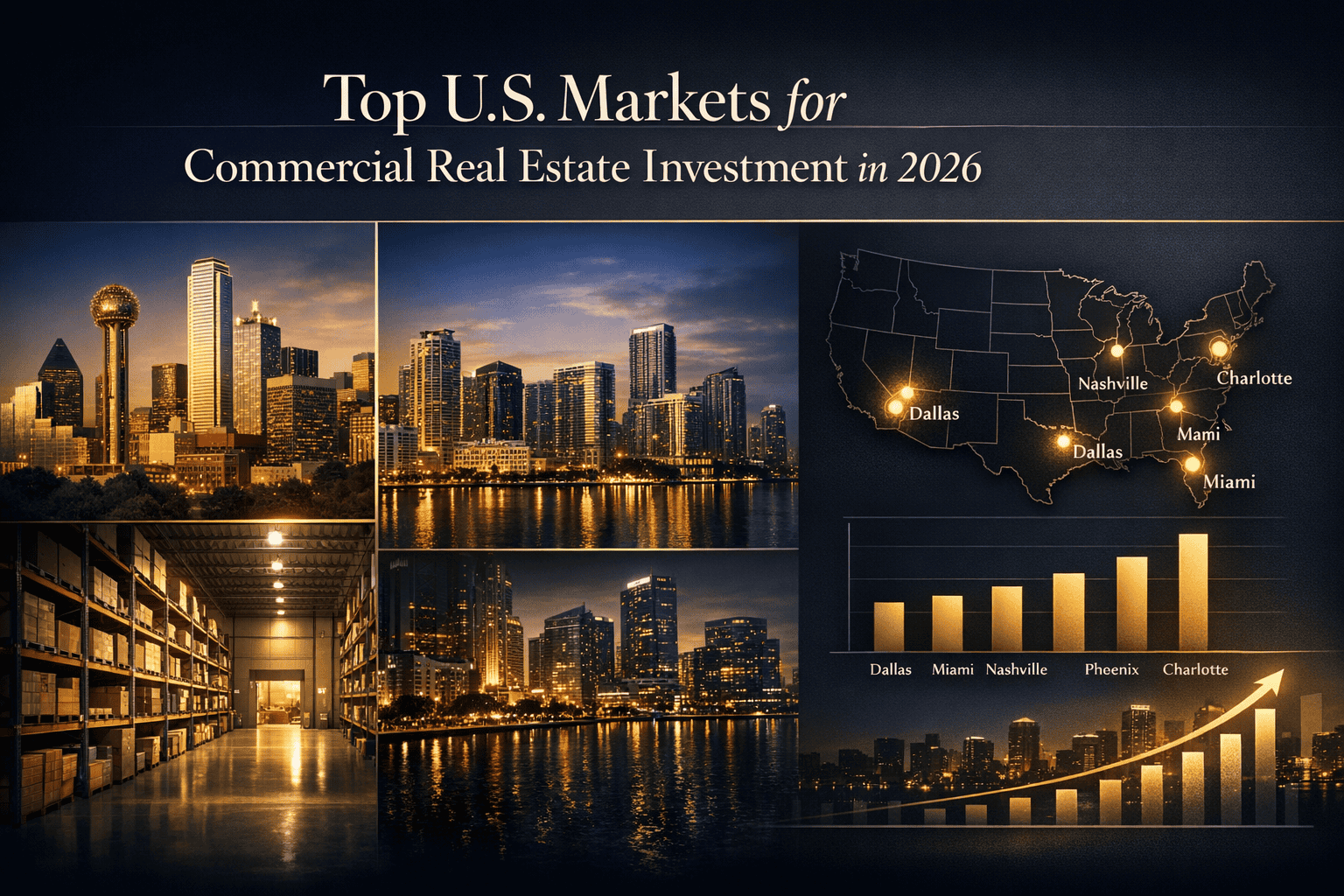
As we look ahead to 2026, savvy commercial real estate investors are repositioning their portfolios to capitalize on the most promising markets across the United States. Shifting demographics, remote work normalization, infrastructure investment, and evolving supply chains are reshaping where capital flows — and which cities are poised for outsized returns. Whether you're targeting office, industrial, multifamily, or retail assets, understanding which markets offer the strongest fundamentals is essential for making informed decisions.
At Cordura, we track market data, cap rate trends, and economic indicators across the country so our clients can invest with confidence. Below, we've identified the top U.S. markets for commercial real estate investment in 2026, based on job growth, population trends, construction pipelines, and investor demand.
1. Dallas-Fort Worth, Texas
Dallas-Fort Worth (DFW) continues to dominate as one of the most resilient commercial real estate markets in the nation. The metro area has consistently ranked among the top destinations for corporate relocations, with major companies from California, New York, and Illinois establishing headquarters or regional offices in the Metroplex. In 2026, DFW is expected to see continued strength in industrial and logistics properties, driven by its central location and robust transportation infrastructure.
- Industrial vacancy rates remain near historic lows, with e-commerce and third-party logistics tenants driving demand.
- Office absorption is recovering as hybrid work stabilizes, particularly in suburban submarkets like Plano and Frisco.
- Multifamily demand remains elevated due to consistent in-migration from higher-cost states.
Investors looking to diversify into Sun Belt markets will find DFW offers a compelling risk-adjusted return profile. Explore commercial real estate opportunities in Texas with Cordura's dedicated regional experts.
2. Nashville, Tennessee
Nashville has evolved from a music and tourism hub into one of America's most dynamic commercial real estate markets. The city's economy has diversified significantly, with healthcare, technology, and advanced manufacturing sectors all expanding rapidly. In 2026, Nashville is expected to benefit from continued population growth, a strong employment base, and a maturing commercial infrastructure.
- Life sciences and medical office assets are experiencing strong demand, anchored by Vanderbilt University Medical Center and a growing biotech ecosystem.
- Mixed-use developments in neighborhoods like The Gulch and Germantown are attracting institutional capital.
- Net lease retail continues to perform well, supported by rising household incomes and consumer spending.
Nashville's cap rates, while compressing, still offer a premium over coastal gateway markets, making it an attractive target for value-add investors seeking yield in a high-growth environment.
3. Phoenix, Arizona
Phoenix stands out as one of the fastest-growing metros in the United States, and its commercial real estate market reflects that momentum. The semiconductor boom — fueled by TSMC's massive chip fabrication campus in the northern suburbs — has catalyzed an industrial and manufacturing real estate renaissance in the region. Beyond tech manufacturing, Phoenix benefits from a low-cost business environment, favorable tax policies, and a growing workforce.
- Industrial and flex space demand is surging as semiconductor supply chain companies cluster near major manufacturers.
- Retail fundamentals are strong, with expanding retail corridors in Scottsdale, Chandler, and Gilbert.
- Office market is stabilizing with new Class A deliveries attracting tech and financial services tenants.
Phoenix is increasingly on the radar of institutional investors who previously focused exclusively on coastal markets. The city's long-term infrastructure investment and utility expansion make it a compelling long-term play.
4. Miami, Florida
Miami has undergone a remarkable transformation over the past several years, cementing its status as a major financial and technology hub. The influx of hedge funds, private equity firms, and venture capital groups — along with their employees — has created sustained demand across every major commercial real estate sector. In 2026, Miami's commercial market is expected to remain one of the most globally competitive in the country.
- Class A office in Brickell and Downtown Miami commands some of the highest rent growth in the nation.
- Luxury retail and hospitality assets continue to attract international capital, particularly from Latin America and Europe.
- Industrial demand in the airport and port submarkets remains robust, supported by South Florida's position as a gateway to Latin American trade.
For investors seeking international capital flows and high-demand assets, Miami offers a unique combination of global connectivity and domestic growth. Discover Florida commercial properties listed through Cordura's marketplace.
5. Charlotte, North Carolina
Charlotte has quietly emerged as one of the most balanced commercial real estate markets in the Southeast. As the second-largest banking center in the United States behind New York, Charlotte boasts a sophisticated financial services base that anchors its office market. Meanwhile, population growth and corporate expansion are fueling demand for industrial, multifamily, and mixed-use developments across the metro.
- Financial district office assets continue to perform, with banks and fintech companies expanding their footprints.
- Industrial submarkets along I-85 and I-77 are attracting logistics and distribution tenants.
- Suburban retail centers are thriving as residential growth pushes outward into communities like Ballantyne, Huntersville, and Concord.
Charlotte's relative affordability compared to Nashville and Atlanta makes it an increasingly attractive target for investors seeking value before further cap rate compression.
6. Austin, Texas
Austin's commercial real estate market faced a correction in 2024 and 2025 following an oversupply of office and multifamily product delivered during the post-pandemic boom. However, 2026 presents a renewed opportunity as the market rebalances. Austin remains a tier-one technology hub, with Tesla, Apple, Oracle, and dozens of high-growth startups maintaining significant presences in the city.
- Office sublease absorption is improving as tech companies right-size and new tenants enter the market at discounted rates.
- Industrial development continues in eastern Austin and surrounding Travis and Williamson counties.
- Mixed-use and retail assets are performing well in high-traffic corridors like Domain Northside and South Congress.
Counter-cyclical investors may find Austin's current pricing dislocation an exceptional entry point ahead of what analysts project will be a significant recovery cycle through the latter half of the decade.
7. Raleigh-Durham, North Carolina
The Research Triangle remains one of the most knowledge-economy-driven commercial real estate markets in the country. With Duke University, UNC Chapel Hill, and NC State University anchoring a world-class research ecosystem, Raleigh-Durham has attracted pharmaceutical, biotech, and technology companies at a remarkable pace. In 2026, the market is set to benefit from continued lab space demand, strong multifamily absorption, and expanding industrial corridors.
- Life sciences and lab office represent the highest-demand sector, with limited supply creating upward rent pressure.
- Tech office leasing is active, particularly in Research Triangle Park and Downtown Raleigh.
- Industrial growth is accelerating as the region's population expansion drives logistics and last-mile delivery demand.
8. Indianapolis, Indiana
Indianapolis is often overlooked in favor of Sun Belt darlings, but the city offers a compelling case for commercial real estate investment in 2026. As a major logistics and distribution hub at the crossroads of several interstate highways, Indianapolis has become a prime location for e-commerce fulfillment centers, cold storage facilities, and advanced manufacturing operations.
- Industrial cap rates remain higher than coastal and Sun Belt markets, offering attractive yield opportunities.
- Distribution and fulfillment leasing is driven by Amazon, FedEx, and a growing roster of third-party logistics providers.
- Healthcare real estate is a strong performer, anchored by major health systems including IU Health and Ascension.
For investors focused on cash flow and value fundamentals, Indianapolis represents a disciplined investment opportunity in a market with strong long-term demand drivers.
Key Factors Driving Market Selection in 2026
When evaluating commercial real estate markets for investment in 2026, investors should weigh a combination of macroeconomic and local market factors:
- Population and employment growth: Markets with consistent in-migration and job creation tend to sustain demand across all asset classes.
- Infrastructure investment: Public sector spending on transportation, broadband, and utilities signals long-term confidence in market viability.
- Supply pipeline: Understanding new construction deliveries relative to absorption helps identify markets where rental rate growth is most sustainable.
- Cap rate spreads: Comparing local cap rates to the 10-year Treasury yield helps investors assess the risk premium they're being compensated for.
- Regulatory environment: Business-friendly states with lower tax burdens and streamlined permitting attract more corporate tenants and development activity.
How Cordura Helps You Invest in the Right Markets
Navigating the complexity of commercial real estate investment across multiple markets requires both data and expertise. At Cordura, we provide investors and property seekers with access to curated listings, market intelligence, and a network of experienced professionals who understand the nuances of each local market. Whether you're a first-time commercial investor or an institutional player expanding your portfolio, we're here to help you find opportunities that align with your investment strategy.
Browse our current investment property listings to find commercial assets in the top U.S. markets for 2026. Our team is ready to connect you with the right properties, partners, and market data to make your next investment a success.
Final Thoughts
The commercial real estate landscape in 2026 rewards investors who are proactive, data-driven, and willing to look beyond the traditional gateway markets of New York, Los Angeles, and Chicago. Sun Belt cities, secondary markets with strong knowledge economies, and logistics-driven Midwest metros all offer compelling investment cases — each with its own risk-return profile. By aligning your investment thesis with markets that have strong demographic tailwinds, diversified economic bases, and favorable supply dynamics, you can position your portfolio for meaningful growth in the years ahead.
Cordura is committed to being your trusted partner in every step of the commercial real estate investment process — from market research to closing. Reach out to our team today to discuss how we can help you capitalize on the top markets of 2026.