
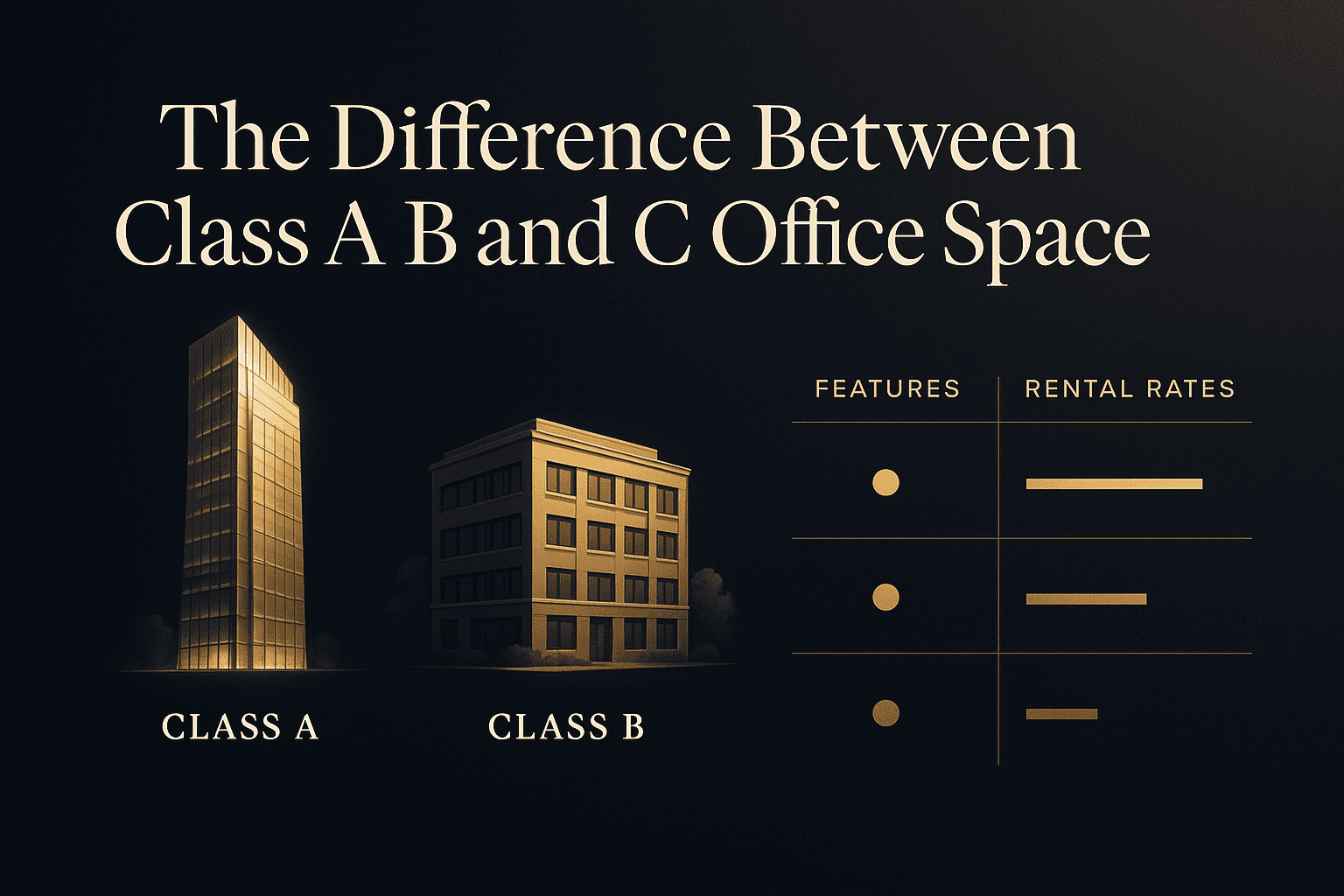
Understanding Office Space Classifications: Class A, B, and C Explained
When searching for commercial office space, you'll quickly encounter a classification system that categorizes buildings into three tiers: Class A, Class B, and Class C. These designations aren't arbitrary — they reflect a building's quality, amenities, location, age, and overall desirability in the marketplace. Whether you're an investor evaluating assets or a business owner scouting your next headquarters, understanding these distinctions is critical to making informed real estate decisions.
At Cordura, we work with clients across the full spectrum of commercial real estate, and one of the most common questions we receive is: what's the real difference between Class A, B, and C office space? This guide breaks it all down so you can move forward with confidence.
What Is Class A Office Space?
Class A office space represents the highest tier in commercial real estate. These are premium buildings that command top-of-market rental rates and attract prestigious tenants, including Fortune 500 companies, major law firms, and financial institutions. Class A properties are typically located in prime business districts or major metropolitan areas where visibility, accessibility, and prestige matter most.
Key Characteristics of Class A Office Buildings
- Prime Location: Situated in central business districts (CBDs) or highly desirable suburban corridors with easy highway and transit access.
- Modern Construction or Major Renovation: Typically built within the last 10–15 years or recently gut-renovated to meet contemporary standards.
- High-End Finishes: Marble lobbies, floor-to-ceiling glass, premium fixtures, and architect-designed common areas.
- Advanced Technology Infrastructure: Fiber-optic connectivity, smart building systems, and state-of-the-art HVAC and security systems.
- Premium Amenities: On-site fitness centers, conference facilities, upscale dining options, and concierge services.
- Professional Management: Managed by experienced property management companies that maintain high service standards.
- Strong Occupancy Rates: High demand keeps vacancy rates low, making these properties attractive to investors.
Because of these features, Class A office spaces command rental rates that are significantly above the market average — often 20% to 50% higher than Class B properties in the same market. For investors, Class A assets are generally considered lower-risk, stable holdings, though acquisition costs are correspondingly higher. If you're exploring commercial real estate investment opportunities at the premium end of the market, Class A properties deserve close attention.
What Is Class B Office Space?
Class B office space occupies the middle ground of the office market. These buildings offer solid functionality and reasonable amenities at more moderate price points, making them the most abundant category in most U.S. markets. Class B properties attract a wide range of tenants — from growing startups to established mid-size businesses — who want quality space without paying Class A premiums.
Key Characteristics of Class B Office Buildings
- Good but Not Premium Locations: Often found just outside CBDs, in suburban office parks, or in secondary markets.
- Older Construction with Updates: Typically 15–30 years old with some level of renovation to interiors and mechanical systems.
- Functional Finishes: Comfortable and professional, but without the high-end materials found in Class A buildings.
- Adequate Technology: Standard broadband connectivity and functional HVAC, though not cutting-edge.
- Basic Amenities: May include a lobby café, shared conference rooms, and parking facilities.
- Competitive Rental Rates: Below Class A pricing, making them attractive to cost-conscious tenants seeking value.
- Value-Add Potential: A popular target for investors looking to renovate and reposition properties to increase returns.
Class B properties are particularly interesting from an investment perspective. Many investors pursue value-add strategies — acquiring Class B buildings at a discount, upgrading mechanical systems, refreshing common areas, and repositioning the asset as a higher-quality property to attract better tenants and justify higher rents. This strategy can yield strong returns in the right market conditions. To learn more about how Cordura helps investors identify these opportunities, visit our office space listings page.
What Is Class C Office Space?
Class C office space sits at the lowest tier of the classification system. These properties are typically older buildings that have seen minimal renovation, are located in less desirable areas, and offer below-market rental rates. While they may not appeal to high-profile tenants, Class C spaces serve an important role in the market — providing affordable office accommodation for small businesses, nonprofits, government agencies, and startups operating on tight budgets.
Key Characteristics of Class C Office Buildings
- Older Buildings: Usually 30+ years old with limited or no significant renovation since original construction.
- Functional but Dated Infrastructure: Older HVAC, electrical, and plumbing systems that may require maintenance attention.
- Basic Finishes: Minimal aesthetic upgrades; spaces are utilitarian rather than impressive.
- Limited Amenities: Few if any on-site amenities beyond basic parking and building access.
- Lower Rents: The most affordable office option in any given market, making them accessible to budget-conscious occupants.
- Secondary or Tertiary Locations: Often found in older urban areas, industrial corridors, or less accessible suburban zones.
- Higher Vacancy Potential: More susceptible to economic downturns and shifting tenant preferences.
For investors, Class C properties carry the highest risk profile but can also deliver the highest returns when properly repositioned. Substantial capital investment is typically required to bring these assets up to modern standards. Some investors focus on adaptive reuse strategies — converting Class C office buildings into mixed-use developments, residential lofts, or other property types entirely.
How Are Office Classes Determined?
It's important to understand that there is no universal regulatory body or standardized scoring system that officially assigns office classifications. Instead, classifications are determined by local market consensus — typically among brokers, property managers, developers, and investors who are active in a given market. This means a Class A building in a secondary market like Tulsa may not meet the same standards as a Class A building in Midtown Manhattan.
The key factors that influence classification include:
- Building age and construction quality
- Location and accessibility
- Interior finishes and aesthetic appeal
- Technology and mechanical infrastructure
- Amenities and services offered
- Rental rates relative to the local market
- Quality and reputation of tenants
- Management quality and responsiveness
Because classifications are market-relative, it's always wise to work with an experienced local commercial real estate advisor who understands how properties are positioned within your specific market.
Class A vs. Class B vs. Class C: A Side-by-Side Comparison
To make the distinctions crystal clear, here's a quick comparison across the most important dimensions:
- Rental Rates: Class A (highest) ? Class B (moderate) ? Class C (lowest)
- Location Quality: Class A (prime CBD or top suburban) ? Class B (good suburban or secondary) ? Class C (tertiary or dated urban)
- Building Age: Class A (new or recently renovated) ? Class B (some renovation) ? Class C (older, minimal updates)
- Amenity Level: Class A (premium) ? Class B (functional) ? Class C (basic or minimal)
- Typical Tenants: Class A (Fortune 500, law firms, finance) ? Class B (mid-size businesses, regional firms) ? Class C (small businesses, nonprofits, startups)
- Investor Appeal: Class A (stable, core investment) ? Class B (value-add opportunity) ? Class C (opportunistic, redevelopment)
Which Office Class Is Right for Your Business?
Choosing the right office class depends on your specific business goals, budget, brand image, and operational needs. Here are some guiding questions to help you decide:
- What is your budget? If cost control is a priority, Class B or C space may allow you to allocate more resources toward growth rather than real estate overhead.
- How important is brand image? If you regularly host clients or need to project prestige, Class A space may be worth the premium.
- How long is your lease term? Longer commitments may justify investing in higher-quality space for employee satisfaction and retention.
- What are your technology needs? Companies with intensive IT requirements may need Class A infrastructure to support operations.
- Are you in a growth phase? Flexible Class B spaces may offer more favorable lease terms and room to scale.
Which Office Class Is Best for Investors?
From an investment standpoint, each class serves a different strategy and risk profile:
- Class A is ideal for investors seeking stable, long-term cash flow with creditworthy tenants. Cap rates are typically lower, but so is risk.
- Class B is the sweet spot for value-add investors. With the right improvements and management, Class B assets can be repositioned for superior returns.
- Class C suits opportunistic investors with experience in complex repositioning, redevelopment, or adaptive reuse projects.
Understanding where a property falls in this spectrum — and where you want it to be — is foundational to building a successful commercial real estate portfolio. Cordura's team of specialists can help you assess opportunities across all three classes. Explore our find commercial real estate resources to get started.
The Impact of Market Conditions on Office Classifications
Office space classifications are not static. Market dynamics, economic cycles, and shifting tenant preferences can cause properties to move between classifications over time. A Class B building that receives a major renovation and attracts premium tenants may be reclassified as Class A. Conversely, a Class A building that ages without investment may slip to Class B as newer, better-equipped competitors enter the market.
The rise of remote and hybrid work has also reshaped demand patterns across all three classes. Many companies are downsizing their footprints but upgrading their space quality — a trend known as "flight to quality" — which has increased demand for Class A space while putting pressure on older Class B and C assets in some markets.
Final Thoughts: Navigating Office Classifications with Cordura
Understanding the difference between Class A, B, and C office space is more than an academic exercise — it's a practical framework that shapes leasing decisions, investment strategies, and long-term portfolio performance. Each class offers distinct advantages and trade-offs, and the right choice depends entirely on your goals, resources, and market context.
At Cordura, we specialize in helping investors, business owners, and property seekers navigate the complexities of the commercial real estate market with clarity and confidence. Whether you're looking for a trophy Class A headquarters in a major metro or a value-add Class B opportunity in a growing secondary market, our team has the expertise and market knowledge to guide you every step of the way.
Ready to find your ideal office space or investment property? Connect with Cordura today and let us put our commercial real estate expertise to work for you.