
Commercial vs Residential Real Estate: Which Investment Path Is Right for You?
Whether you're a first-time investor or a seasoned property buyer, one of the most fundamental decisions you'll face is choosing between commercial real estate and residential real estate. Both asset classes offer compelling opportunities, but they come with distinct risk profiles, income potential, and management demands. Understanding the core differences can help you align your investment strategy with your financial goals.
What Is Commercial Real Estate?
Commercial real estate (CRE) refers to properties used exclusively for business purposes. This broad category includes office buildings, retail centers, industrial warehouses, multifamily apartment complexes (typically 5+ units), hotels, and mixed-use developments. Investors in commercial properties typically lease space to businesses under long-term agreements, generating consistent income streams.
At Cordura, we specialize in helping investors navigate the US commercial real estate market — from identifying high-yield opportunities to closing complex transactions with confidence. Explore our commercial real estate investing resources to learn how CRE can power your portfolio.
What Is Residential Real Estate?
Residential real estate encompasses properties designed for people to live in — single-family homes, condominiums, townhouses, and small multifamily buildings (typically 1–4 units). Investors in this space may rent properties to individual tenants or families, or buy and sell homes for profit through strategies like fix-and-flip.
Key Differences: Commercial vs Residential Real Estate
1. Income Potential and Returns
One of the most significant advantages of commercial real estate is its higher income potential. Commercial leases tend to generate stronger cash flow due to higher rental rates and longer lease terms — often 3 to 10 years or more. Residential leases, by contrast, are typically month-to-month or annual, which can increase vacancy risk.
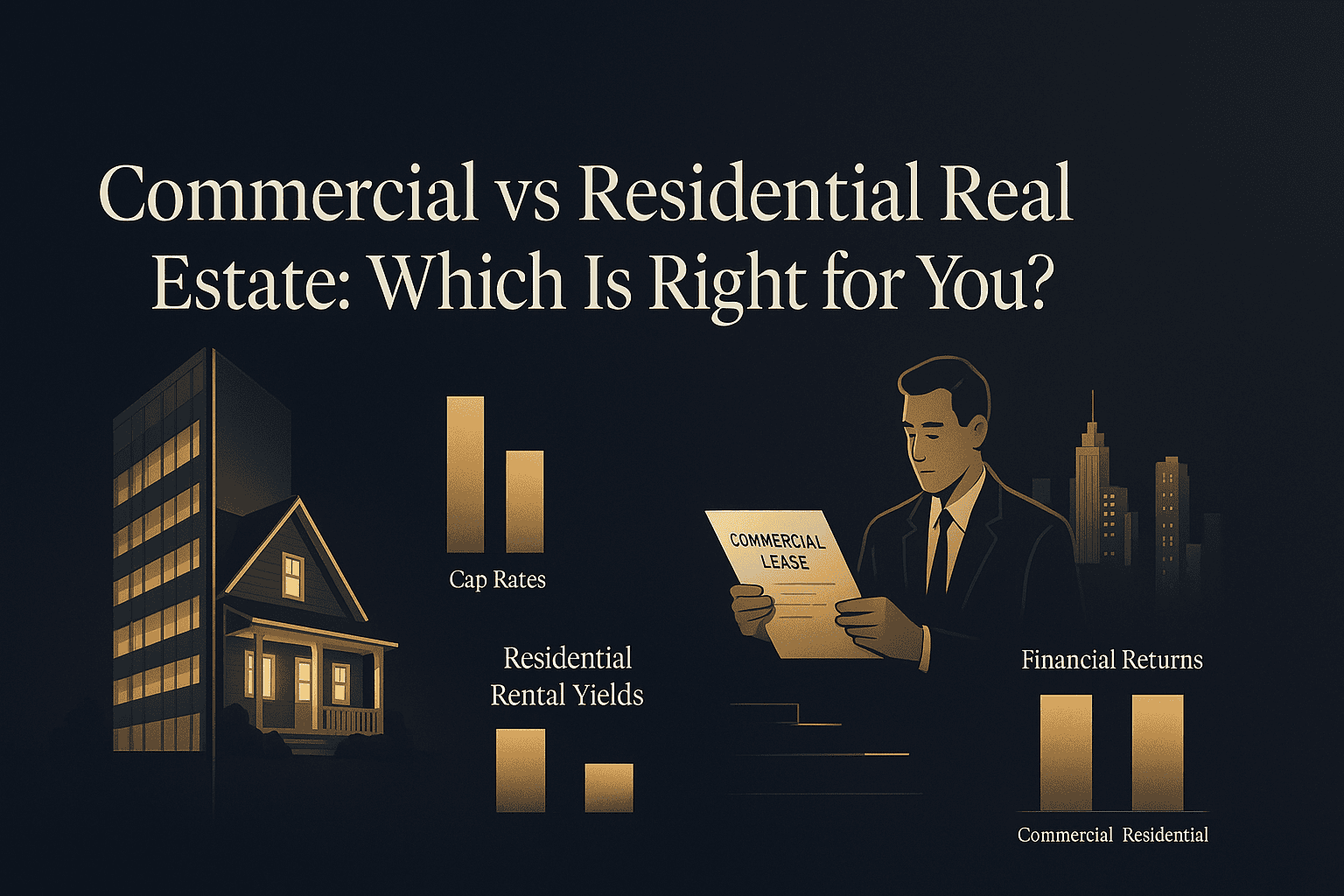
- Commercial cap rates generally range from 4% to 10%+, depending on asset type and location.
- Residential rental yields typically range from 3% to 6% in most US markets.
- Commercial leases often include triple net (NNN) provisions, shifting operating expenses like taxes, insurance, and maintenance to the tenant.
2. Lease Structures and Tenant Stability
Commercial tenants — particularly corporations, national retailers, and established businesses — often sign multi-year leases, providing landlords with predictable, long-term income. This stability is a hallmark of commercial real estate investing. Residential tenants, while sometimes reliable, are more likely to relocate, creating turnover costs and income gaps.
3. Property Management Complexity
Commercial properties generally require more sophisticated management. You'll deal with zoning laws, Americans with Disabilities Act (ADA) compliance, environmental regulations, and complex lease negotiations. However, many commercial leases place maintenance responsibilities on tenants, which can actually reduce a landlord's day-to-day management burden compared to residential properties.
Residential real estate tends to be more management-intensive on a per-unit basis. Landlords are often responsible for appliance repairs, landscaping, and tenant relations — tasks that can be delegated to a property manager, but at an additional cost.
4. Financing and Capital Requirements
Getting into commercial real estate typically requires more capital upfront. Down payments for commercial loans usually range from 20% to 35%, and lenders scrutinize the property's income potential (via debt service coverage ratios) as much as the borrower's creditworthiness. Commercial loans may also carry shorter amortization periods and balloon payment structures.
Residential real estate offers more accessible financing options. Conventional mortgages, FHA loans, and VA loans allow buyers to enter the market with as little as 3.5% down, making it a more approachable entry point for new investors.
5. Market Sensitivity and Risk
Commercial real estate values are closely tied to business cycles and economic conditions. During recessions, office and retail vacancies can spike, reducing property income and value. However, certain CRE sectors — such as industrial, data centers, and multifamily — have demonstrated remarkable resilience even in economic downturns.
Residential real estate is influenced by local housing supply, interest rates, and population trends. While home values can fluctuate, the consistent demand for housing makes residential properties relatively stable long-term investments.
6. Tax Advantages
Both commercial and residential real estate offer significant tax benefits, including depreciation deductions, mortgage interest deductions, and the ability to defer capital gains through 1031 exchanges. Commercial properties often benefit from accelerated depreciation schedules (via cost segregation studies), which can create substantial short-term tax savings for qualified investors.
Pros and Cons at a Glance
- Commercial Real Estate Pros: Higher income potential, longer lease terms, triple net structures, portfolio diversification, strong depreciation benefits
- Commercial Real Estate Cons: Higher entry costs, complex financing, greater economic sensitivity, steeper learning curve
- Residential Real Estate Pros: Lower barrier to entry, accessible financing, familiar market dynamics, strong resale demand
- Residential Real Estate Cons: Lower yields, higher tenant turnover, hands-on management, limited scalability
Who Should Invest in Commercial Real Estate?
Commercial real estate is best suited for investors who:
- Have significant capital to deploy or access to commercial financing
- Seek higher, more stable income streams over the long term
- Want to diversify beyond the residential market
- Are comfortable with complex transactions and longer due diligence processes
- Aim to build institutional-grade wealth through property ownership
If you're ready to explore CRE opportunities tailored to your investment goals, browse available commercial properties on Cordura and connect with our team of expert advisors.
Who Should Invest in Residential Real Estate?
Residential real estate is a strong fit for investors who:
- Are newer to real estate investing and want a familiar entry point
- Have limited startup capital but strong personal credit
- Prefer simpler transaction structures and well-understood market dynamics
- Want to build equity gradually through buy-and-hold or fix-and-flip strategies
Can You Invest in Both?
Absolutely. Many successful US real estate investors maintain a diversified portfolio that includes both commercial and residential properties. Residential holdings can provide steady baseline income while commercial assets drive higher returns and portfolio appreciation. As your experience and capital base grow, transitioning a portion of your portfolio into commercial real estate is a natural and rewarding progression.
Understanding market trends in both sectors is key to making informed decisions. Read our latest US real estate market trends analysis to stay ahead of shifts that could impact your investments.
Final Thoughts: Making the Right Choice for Your Goals
There is no universally "better" option between commercial and residential real estate — the right choice depends on your financial situation, risk tolerance, investment timeline, and long-term goals. Commercial real estate offers superior income potential and long-term wealth-building power, while residential real estate provides accessibility and a lower barrier to entry.
At Cordura, we're committed to helping US investors, buyers, and property seekers make informed decisions in both the commercial and residential markets. Whether you're evaluating your first investment property or expanding a sophisticated portfolio, our team is here to guide every step of your journey.