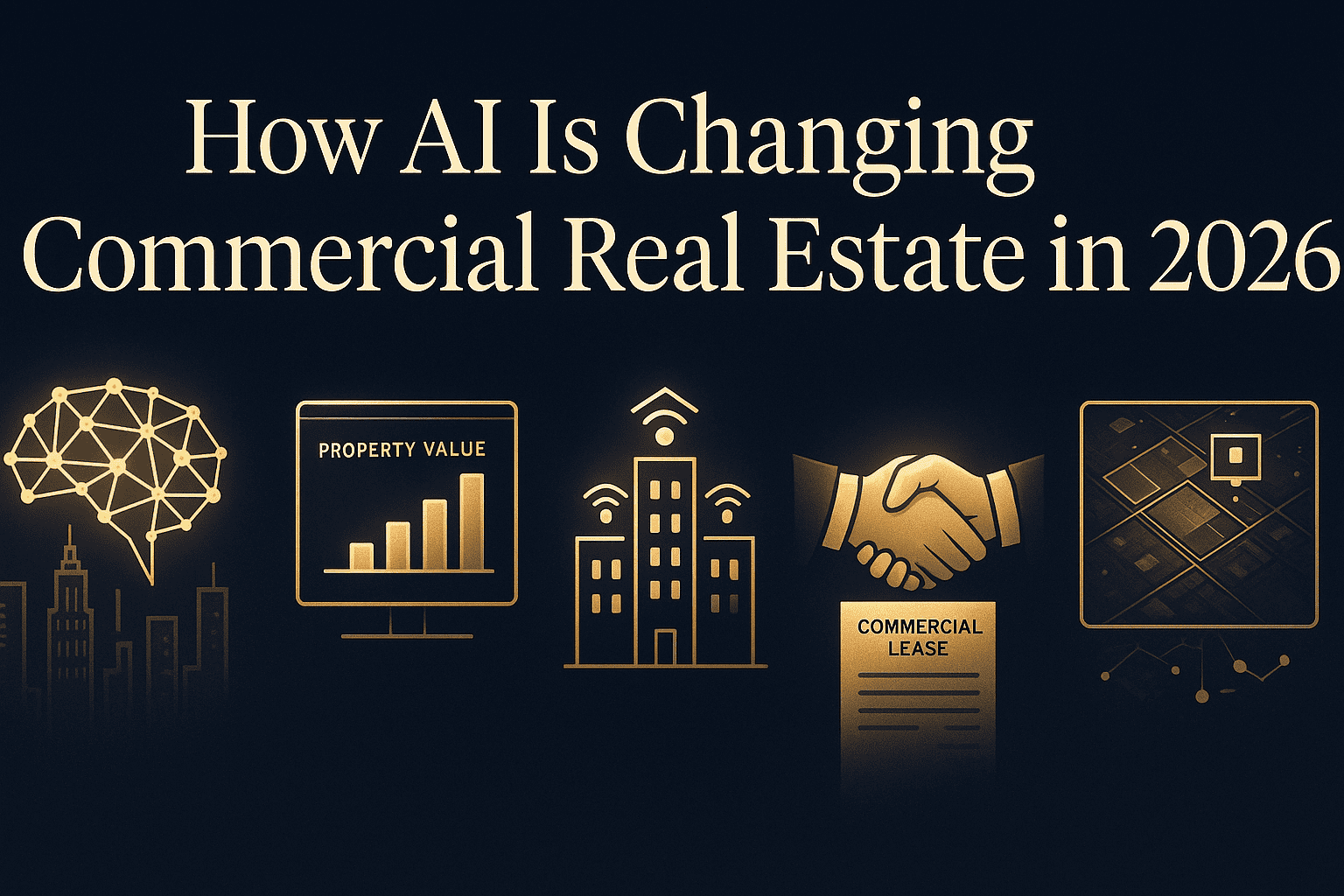
How AI Is Transforming Commercial Real Estate in 2026
Artificial intelligence is no longer a futuristic concept in commercial real estate — it is the engine driving decisions, valuations, and transactions right now. In 2026, AI has moved from pilot programs and proof-of-concept demos into the operational core of how investors, brokers, and property managers do business across the United States. At Cordura, we are at the forefront of this transformation, helping our clients leverage smarter tools to make better investments.
AI-Powered Property Valuation: The End of Guesswork
Traditional commercial property appraisals relied heavily on comparable sales, manual market surveys, and appraiser judgment. In 2026, machine learning models trained on billions of data points — including zoning changes, foot traffic patterns, interest rate movements, and macroeconomic indicators — now deliver valuation estimates in minutes with accuracy that rivals seasoned appraisers.
These automated valuation models (AVMs) are particularly powerful for commercial investment properties, where subtle shifts in cap rates and local demand can dramatically affect asset value. AI allows investors to stress-test dozens of scenarios before committing capital, reducing risk while accelerating deal velocity.
- Real-time market adjustments: AI continuously recalibrates valuations as new market data flows in.
- Multi-variable analysis: Models factor in crime rates, infrastructure upgrades, population migration, and tenant credit risk simultaneously.
- Reduced human bias: Algorithmic valuations minimize the subjective errors that can inflate or deflate appraisals.
Predictive Analytics: Knowing Where the Market Is Heading
One of the most powerful applications of AI in commercial real estate is predictive analytics. In 2026, platforms powered by large language models and deep learning networks can forecast rental rate trends, vacancy cycles, and neighborhood revitalization timelines with a precision that was unimaginable just five years ago.
For investors scouting commercial real estate listings across emerging US markets, predictive tools surface opportunities before they become mainstream knowledge — a critical edge in competitive environments like industrial logistics hubs, suburban office conversions, and mixed-use developments.
Key Areas Where Predictive AI Is Delivering Value
- Lease expiration risk modeling: Identifying portfolios with high near-term rollover before acquiring them.
- Tenant default prediction: Scoring existing and prospective tenants using financial health signals and industry trends.
- Market timing optimization: Flagging ideal entry and exit windows based on cycle positioning.
- Demand forecasting by asset class: Distinguishing which industrial, retail, or office subtypes will outperform in specific metros.
AI in Due Diligence: Faster, Deeper, Smarter
Due diligence has historically been one of the most time-intensive and costly stages of any commercial real estate transaction. AI-driven document review tools now scan thousands of pages of lease agreements, environmental reports, title documents, and financial statements in hours rather than weeks. Natural language processing (NLP) models extract key clauses, flag anomalies, and summarize risk exposures — empowering legal and investment teams to focus on strategy rather than paperwork.
In 2026, AI due diligence platforms have also integrated satellite imagery analysis, which automatically detects structural issues, unauthorized construction, or environmental encroachments on commercial parcels. This level of insight was previously only available through expensive on-site inspections.
Smart Building Technology and Asset Management
AI is not just changing how deals are made — it is transforming how commercial assets are operated after acquisition. Smart building platforms powered by AI now optimize energy consumption, predict equipment maintenance needs before failures occur, and adjust HVAC systems in real time based on occupancy patterns. The result is significant operating cost reduction and stronger net operating income (NOI) — metrics that directly enhance asset value.
AI-Driven Property Management Capabilities in 2026
- Predictive maintenance: IoT sensors combined with AI models flag mechanical issues weeks before they become costly failures.
- Energy optimization: Machine learning reduces energy waste by up to 30% in commercial buildings.
- Tenant experience platforms: AI-powered apps manage service requests, access control, and amenity bookings, improving retention.
- Dynamic space utilization: AI tracks how tenants use space and recommends lease restructuring or renovation strategies.
AI and the Commercial Real Estate Brokerage Experience
For buyers and tenants searching for commercial space, AI has fundamentally changed the discovery and matching process. Intelligent search platforms now understand natural language queries — a buyer can describe their ideal industrial facility with specific ceiling heights, power capacity, and proximity to logistics corridors, and an AI engine will surface the most relevant options instantly.
Virtual property tours powered by generative AI allow prospective tenants and investors to explore buildings remotely with photorealistic detail, while AI negotiation assistants help brokers model counteroffers and lease term scenarios in real time. At Cordura, our commercial space search experience is continuously enhanced by these technologies to deliver better matches and faster closings for our clients.
Risk Management: AI as the New Safety Net
Market volatility, geopolitical risk, and climate-related hazards have made risk management a top priority for commercial real estate stakeholders in 2026. AI models now integrate climate risk scoring into every property analysis, quantifying flood probability, wildfire exposure, and extreme heat impact on asset performance over 10, 20, and 30-year horizons. Lenders and institutional investors increasingly require these AI-generated risk scores before approving financing.
Portfolio-level AI tools also monitor macroeconomic signals — interest rate forecasts, employment data, supply chain disruptions — and alert owners when rebalancing or hedging strategies may be warranted. This systemic approach to risk management is helping commercial real estate owners protect wealth in ways that were not possible before AI.
Challenges and Considerations for AI Adoption
Despite its tremendous promise, AI adoption in commercial real estate is not without challenges. Data quality remains a significant obstacle — AI models are only as good as the data they are trained on, and inconsistencies in property records, lease data, and market reporting can skew outputs. Privacy concerns around tenant data collection and algorithmic transparency are also drawing increased regulatory scrutiny at the state level in 2026.
Additionally, the human element of commercial real estate — relationship-driven deal-making, nuanced negotiation, and local market intuition — remains irreplaceable. The most successful operators in 2026 are those who treat AI as a powerful co-pilot, not a replacement for experienced professionals.
The Cordura Perspective: Embracing AI to Serve You Better
At Cordura, we believe that AI is the greatest opportunity in commercial real estate since the rise of online listings platforms. Our mission is to harness these technologies to deliver faster insights, more accurate valuations, and smarter investment opportunities to every client we serve — whether you are a first-time commercial buyer, a seasoned portfolio investor, or a business seeking your next location.
The commercial real estate landscape in 2026 rewards those who embrace innovation. With Cordura as your partner, you will have access to the AI-driven tools, market intelligence, and expert guidance needed to stay ahead in a rapidly evolving market.
Final Thoughts: The AI-Powered Future Is Already Here
From predictive analytics and automated valuations to smart building management and intelligent lease review, artificial intelligence has become the defining force reshaping commercial real estate in 2026. The companies and investors who integrate these capabilities into their strategies today are building durable competitive advantages that will compound over the years ahead. The question is no longer whether to adopt AI — it is how quickly and how effectively you can deploy it.