
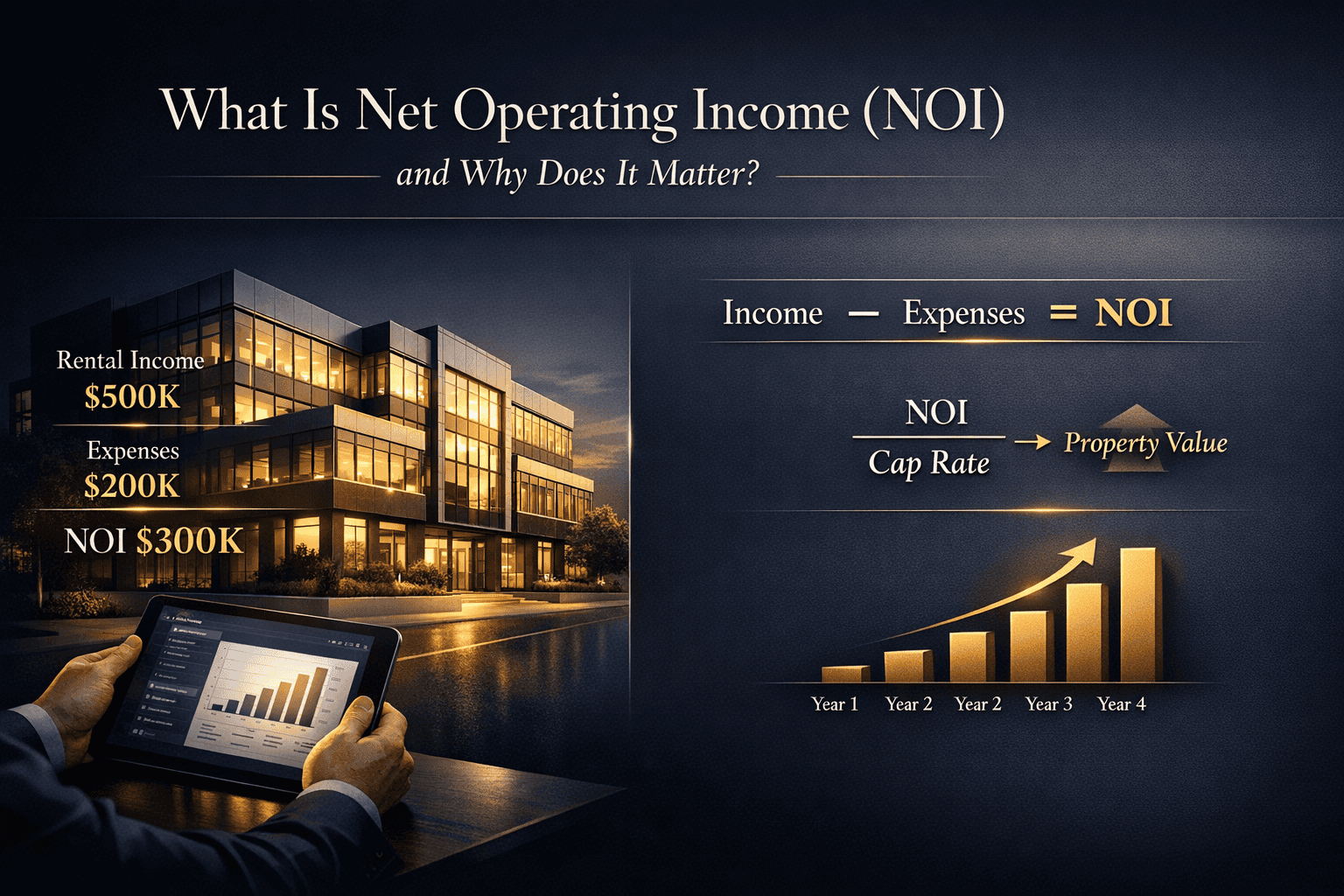
What Is Net Operating Income (NOI) and Why Does It Matter?
If you're exploring commercial real estate investing, few metrics will appear as frequently — or carry as much weight — as Net Operating Income (NOI). Whether you're evaluating an office building, a retail strip center, or a multifamily apartment complex, understanding NOI is essential to making informed investment decisions. At Cordura, we help investors and property seekers cut through the complexity of commercial real estate, and NOI is one concept you simply cannot afford to overlook.
What Is Net Operating Income (NOI)?
Net Operating Income, commonly abbreviated as NOI, is a fundamental financial metric used in commercial real estate to measure the profitability of an income-producing property. In simple terms, NOI represents the annual income generated by a property after all operating expenses have been deducted — but before accounting for taxes, debt service (mortgage payments), and capital expenditures.
The formula for calculating NOI is straightforward:
- NOI = Gross Operating Income – Operating Expenses
Where Gross Operating Income is the total potential rental income minus vacancy and credit losses, and Operating Expenses include costs such as property management fees, insurance, utilities, maintenance, and repairs.
What Is Included in NOI?
To calculate NOI accurately, you need a clear picture of both income sources and allowable expenses. Here's what typically counts:
Income Sources
- Base rental income from tenants
- Parking fees and garage revenue
- Laundry or vending machine income
- Late fees and other ancillary income
- Storage unit rental fees
Operating Expenses (Deducted from Income)
- Property management fees
- Property taxes
- Insurance premiums
- Routine maintenance and repairs
- Utilities (if paid by the landlord)
- Landscaping and janitorial services
- Administrative costs
What Is NOT Included in NOI
It's equally important to know what NOI does not include, as this is a common source of confusion for new investors:
- Mortgage payments or debt service
- Capital expenditures (major improvements or renovations)
- Depreciation and amortization
- Income taxes
By excluding these items, NOI provides a clean, financing-neutral view of a property's operational performance — making it easier to compare properties regardless of how they are financed.
Why Does NOI Matter in Commercial Real Estate?
Net Operating Income is more than just a number on a spreadsheet. It serves as the backbone of nearly every major valuation and investment analysis tool used in commercial real estate today. Here's why NOI is so critically important:
1. It Drives Property Valuation
One of the most powerful uses of NOI is in determining a property's market value using the capitalization rate (cap rate) method. The formula is:
- Property Value = NOI ÷ Cap Rate
For example, if a property generates an NOI of $150,000 annually and the prevailing cap rate in the market is 6%, the estimated property value would be $2,500,000. This means that even small changes in NOI — whether positive or negative — can have a significant impact on a property's overall value. Investors who understand how to analyze cap rates and NOI together are better positioned to identify undervalued opportunities in the market.
2. It Measures Operational Efficiency
NOI gives investors a clear picture of how efficiently a property is being operated. A rising NOI over time suggests that rental income is growing, vacancies are being minimized, and operating costs are being managed effectively. Conversely, a declining NOI may signal rising expenses, high vacancy rates, or poor property management — all red flags for potential investors.
3. It Helps Evaluate Financing Options
Lenders and financial institutions rely heavily on NOI when evaluating loan applications for commercial properties. The Debt Service Coverage Ratio (DSCR) — a key metric for lenders — is calculated directly from NOI:
- DSCR = NOI ÷ Annual Debt Service
Most lenders require a DSCR of at least 1.25, meaning the property's NOI must be at least 25% higher than its annual mortgage payments. Understanding your NOI before approaching lenders can make the financing process far smoother and more predictable.
4. It Enables Apples-to-Apples Comparisons
Because NOI excludes financing costs and taxes — which vary widely from investor to investor — it creates a standardized basis for comparing different properties. Whether you're evaluating a Class A office building in New York or a retail center in Texas, NOI gives you a consistent financial foundation from which to make comparisons. If you're actively building a commercial real estate investment portfolio, mastering NOI analysis will help you evaluate opportunities more objectively.
5. It Supports Investment Strategy and Forecasting
Savvy investors use NOI projections to model future cash flows and estimate returns under different scenarios. By forecasting how NOI might change based on rent increases, expense reductions, or improved occupancy, investors can make more strategic decisions about when to buy, hold, or sell a property.
How to Increase NOI on a Commercial Property
Improving NOI is one of the most direct ways to increase the value of a commercial real estate asset. Here are proven strategies that property owners and investors use to boost NOI:
Increase Rental Income
- Raise rents to market rates at lease renewals
- Improve the property to attract higher-paying tenants
- Add ancillary income streams (parking, storage, signage)
- Reduce vacancy by improving marketing and tenant retention
Reduce Operating Expenses
- Negotiate better contracts with vendors and service providers
- Implement energy-efficient upgrades to lower utility bills
- Conduct regular preventative maintenance to avoid costly repairs
- Review and renegotiate insurance policies annually
Improve Property Management
Efficient property management can dramatically improve NOI by reducing vacancy periods, enforcing lease terms, and keeping operating costs under control. Whether you self-manage or hire a third-party management company, operational excellence directly translates into stronger NOI performance.
Common NOI Mistakes to Avoid
Even experienced investors can make errors when calculating or interpreting NOI. Here are some of the most common pitfalls:
- Using gross income instead of effective gross income: Always account for vacancy and credit losses when calculating NOI. Using 100% occupancy figures will lead to inflated and unrealistic projections.
- Omitting capital expenditures from your analysis: While CapEx is excluded from NOI, smart investors account for it separately when assessing true cash flow and long-term profitability.
- Relying solely on seller-provided figures: Always verify income and expense statements independently. Request actual rent rolls, utility bills, and tax records to validate the NOI figures presented during due diligence.
- Ignoring expense trends: A property with rising operating expenses may show strong NOI today but could see rapid deterioration in the near future. Analyze expense trends over multiple years, not just current figures.
NOI vs. Net Income: What's the Difference?
It's important not to confuse NOI with net income. Net income accounts for all costs, including interest payments, depreciation, and income taxes, giving you the bottom-line profit after all expenses. NOI, by contrast, is a pre-financing, pre-tax measure of operational performance. For commercial real estate analysis, NOI is generally more useful because it isolates the property's performance from the investor's specific financial structure.
Real-World NOI Example
Let's walk through a simple NOI calculation to bring this concept to life:
- Gross Potential Rent: $300,000/year
- Less Vacancy (5%): -$15,000
- Effective Gross Income: $285,000
- Less Operating Expenses: -$95,000 (property taxes, insurance, management, maintenance)
- Net Operating Income (NOI): $190,000
If comparable properties in the area are trading at a 6.5% cap rate, this property's estimated value would be approximately $2,923,077 ($190,000 ÷ 0.065). This simple calculation demonstrates just how powerful NOI is as a valuation tool.
Conclusion: Why NOI Should Be Central to Every Investment Decision
Net Operating Income is the cornerstone of commercial real estate analysis. It empowers investors to accurately value properties, compare opportunities, secure financing, and develop long-term investment strategies. Whether you're a first-time buyer exploring your first income-producing property or a seasoned investor managing a diverse portfolio, a strong command of NOI will give you a significant edge in the market.
At Cordura, we're committed to helping you navigate the commercial real estate landscape with confidence and clarity. Explore our commercial real estate listings to find properties with strong NOI potential across the US market, and let our experienced team guide you every step of the way.